Every garment you sell needs a care label — and it's not just good practice, it's the law. Sell without the right information and you risk customer returns, marketplace delisting, or for exporters, a shipment held at customs. The catch: India, the US, the UK and the EU each phrase the rules slightly differently.
This guide lays out exactly what must appear on a care/content label for each market, in plain language, so a first-time brand owner can get the very first order right and avoid an expensive reprint. Note: this is a practical buyer's overview, not legal advice — confirm the latest rules for your specific product before a large export run.
The four things every care label needs
Almost every market wants these four. Size is commercially expected (and required by most marketplaces) but is not always a strict legal element. Get these four right and you've covered roughly 90% of label compliance everywhere.
India — selling in the domestic market
For garments sold in India, the relevant framework is the Legal Metrology (Packaged Commodities) Rules, which apply to pre-packaged goods including apparel.
- Fibre content — the composition, e.g. "60% Cotton 40% Polyester"
- MRP (inclusive of all taxes) and net quantity
- Manufacturer / packer / importer name and address
- Country of origin — mandatory, especially for marketplace listings
- Month & year of manufacture/import; consumer-care contact
- Care instructions & size — expected by retailers and platforms (Myntra, Amazon, Flipkart) even where not strictly mandated
Marketplace reality: Indian e-commerce platforms enforce country-of-origin and fibre-content declarations strictly. A missing declaration is one of the most common reasons new brands get listings blocked.
United States — the FTC Care Labeling Rule
Two US rules govern apparel labels: the FTC Care Labeling Rule (16 CFR Part 423) and the Textile Fiber Products Identification Act.
- Permanent care label with full instructions for washing/dry-cleaning — must stay legible for the useful life of the garment
- Fibre content by generic name and percentage
- Country of origin — "Made in …"
- Manufacturer identity — company name or a registered RN number
- Care info may use words or symbols; if symbols, they must follow the ASTM care-symbol system
EU & UK — fibre composition + ISO symbols
The EU regulates fibre labelling under Regulation (EU) 1007/2011; the UK applies closely aligned rules post-Brexit.
- Fibre composition is mandatory and must be accurate — often required in the language(s) of the destination country
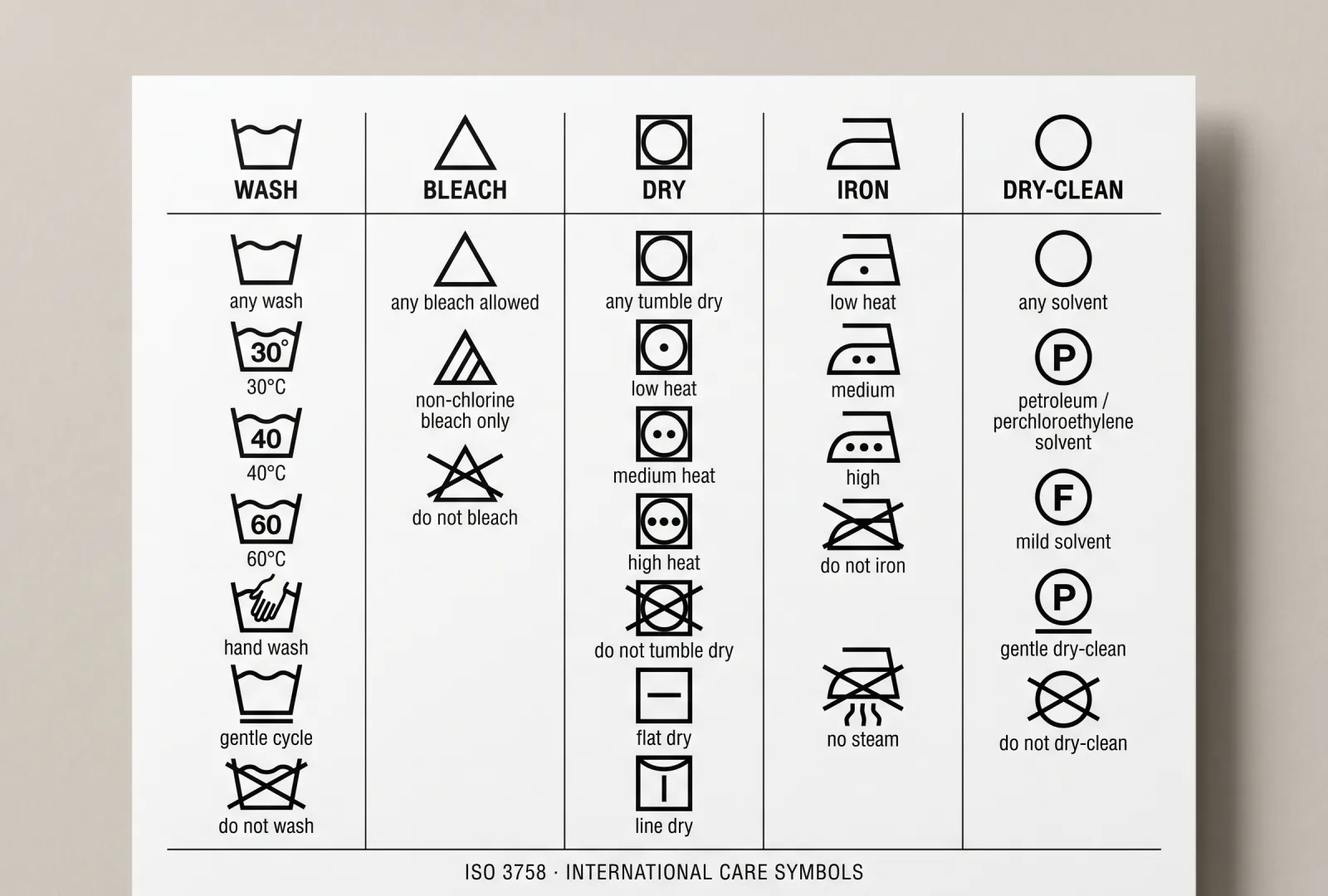
- ISO 3758 care symbols are the norm (wash, bleach, dry, iron, professional care)
- Country of origin and importer/EU-responsible-person details are expected
- Care instructions themselves are largely customary/commercial, but buyers demand them
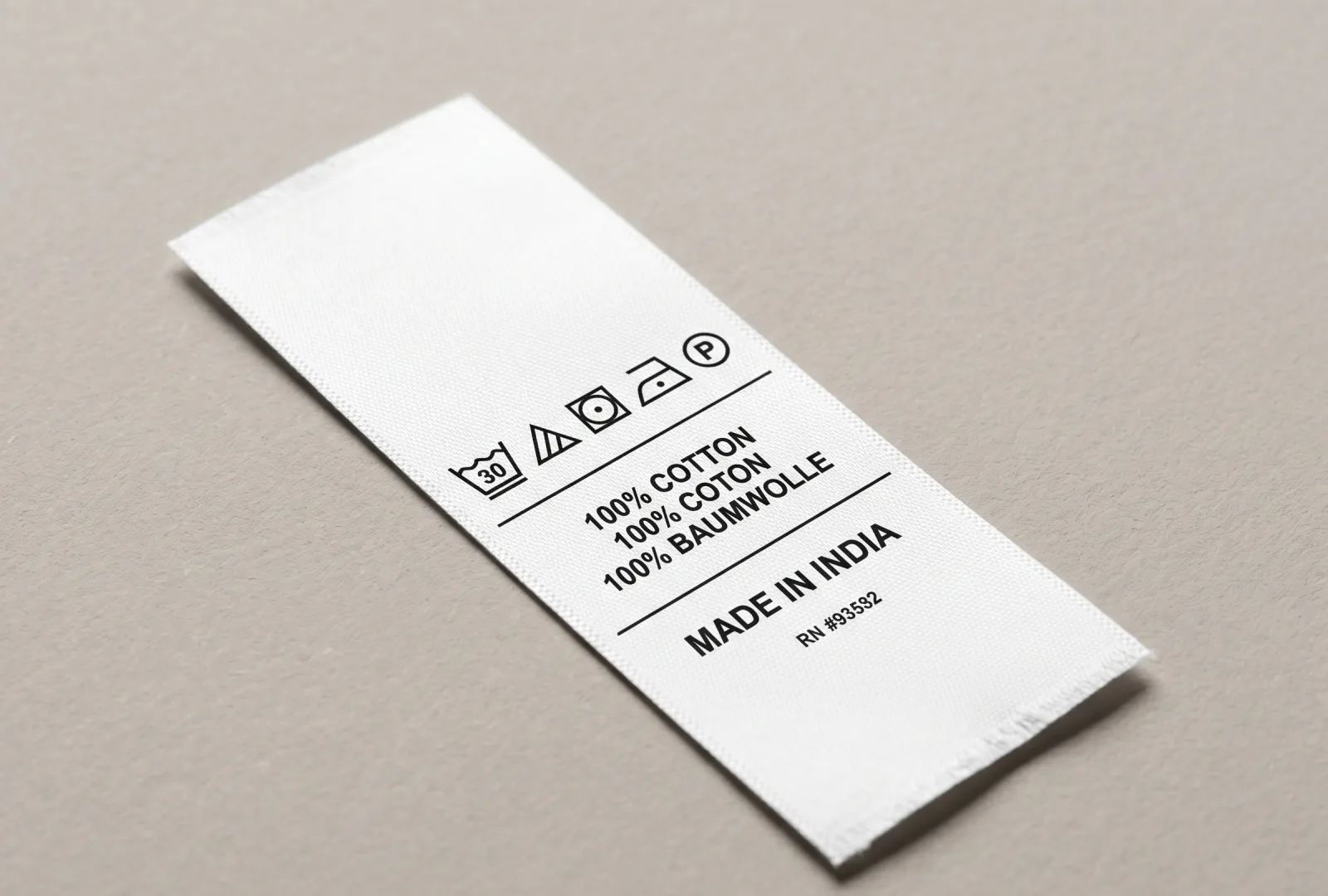
The safe export formula: ISO 3758 wash symbols + short English care text + fibre content + "Made in India" + importer details. This combination is accepted across the US, UK and EU and saves you printing a different label per country.
Market-by-market quick comparison
- Fibre content, MRP, net quantity
- Manufacturer/importer + country of origin
- Care & size expected by marketplaces
- Symbols or words accepted
- Permanent care instructions (16 CFR 423)
- Fibre content + country of origin
- RN or manufacturer name
- ASTM symbols or written words
- Mandatory fibre composition
- Often in destination language
- ISO 3758 care symbols standard
- Importer / origin details expected
- Wrong fibre percentages (must be accurate)
- No country of origin
- Care info that washes off (not permanent)
- English-only labels for EU markets
What material should a care label be?
Because care labels carry dense, small text and symbols, they're almost always printed on taffeta — its tight weave keeps tiny ISO symbols sharp and it survives industrial laundry. Satin printed is a softer alternative for skin-contact positions. Woven is rarely used for care labels because fine text loses legibility in a weave.
- Taffeta printed — export standard, sharpest symbols, lowest cost
- Satin printed — softer for babywear/innerwear care labels
- Placement — inside side seam (hip) or back neck; must be permanent and findable
See our care-label symbols & fabric guide and taffeta labels for exporters for the production detail.
Your care-label checklist before ordering
Get the exact composition and percentages from your fabric supplier. This is the most-checked, most-penalised field.
Use ISO 3758 wash symbols plus short English text — accepted across India, US, UK and EU.
"Made in India", plus your brand name (and RN for US, importer for EU).
Print on taffeta for sharp, permanent symbols; place at the inside seam or back neck.
The short answer
For India, declare fibre content, MRP, net quantity, manufacturer/importer and country of origin — and add care symbols and size because marketplaces expect them. For the US, you must have permanent care instructions, fibre content, country of origin and an RN or manufacturer name. For the EU and UK, fibre composition is mandatory (often in local languages) with ISO 3758 care symbols. The simplest path for a brand selling in India and exporting is a single printed taffeta care label carrying ISO symbols, English care text, accurate fibre content, "Made in India" and your brand identity. Send us your details and we'll lay out a compliant care label before you print.