
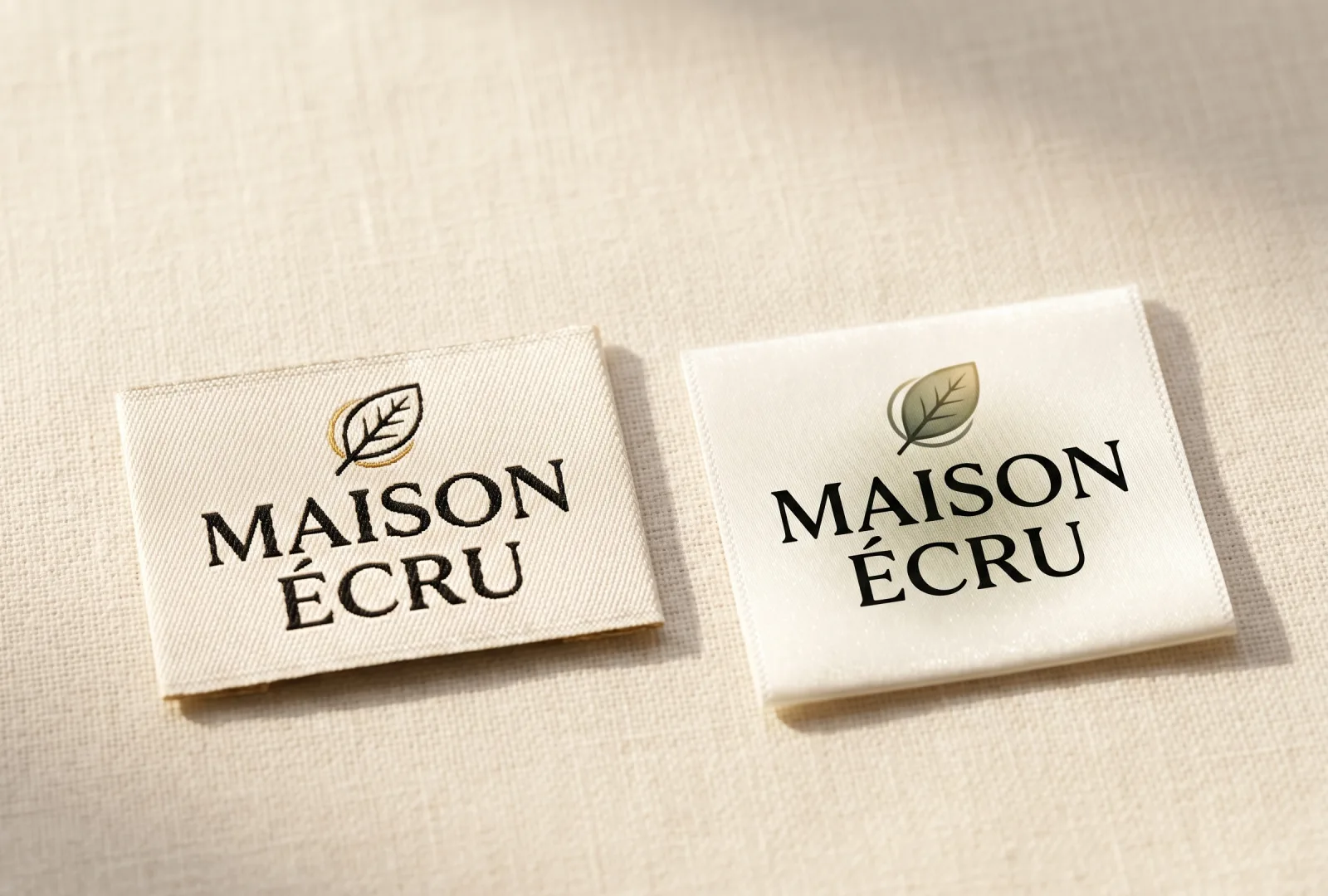
If you've started looking for clothing labels, you've probably heard the same two words on repeat — woven and printed. They cost different amounts, feel different on skin, age differently in the wash, and the wrong choice can quietly cheapen a great garment. This guide cuts through the jargon so you can pick confidently.
The 60-second answer
If your design has 1–8 thread colours and you want a premium tactile feel, woven is almost always the right call. If your design has gradients, photographic detail, more than 8 colours, or you're optimising hard on unit cost — go printed. Everything below is the long-form reasoning.
How they're actually made
A woven label is exactly what it sounds like — your design is woven into the fabric using coloured threads on a jacquard loom. The colour is structural; it can't peel or fade because it isn't sitting on top of the fabric, it is the fabric. Three weave types matter:
- Damask — high thread density, sharpest detail, slightly stiff hand.
- Satin — smooth sheen, softest on skin, the default for casual wear.
- Jacquard — heavy, structured, premium tactile feel for outerwear and denim.
A printed label uses dye-sublimation or screen printing on a fabric base (satin, cotton or taffeta ribbon). The print sits on the surface, but on synthetic bases like satin and taffeta, sublimation dyes fuse into the fabric — closer to woven longevity than people expect.
Where each one wins
- Your logo has 1–8 distinct colours (no gradients, no photo detail)
- Your brand positioning is premium / heritage / boutique
- The label is the customer's first physical touchpoint (neck label)
- You want a label that survives 100+ wash cycles without question
- Your design has gradients, photo detail, or 8+ colours
- You need tagless heat-press for stretch fabric or activewear
- You're producing size tabs or care labels (colour fidelity > feel)
- You're optimising for unit cost on high volumes
The honest truth: most fashion brands need both — a woven neck label for the brand mark, and a printed care label for wash symbols and fibre composition. Not either/or.
The cost question
At low volumes (50–500 pieces), printed labels are cheaper per piece — typically 30–50% less than equivalent woven. As volumes climb past 1,000–2,000 pieces, woven prices drop sharply and the gap narrows. By 5,000+ pieces the difference is small enough that the choice should be driven by feel, not cost.
Wash durability — what really happens
Both label types survive normal wash cycles fine. Where it goes wrong:
- Cheap heat-transfer prints (not the same as printed labels) peel after 5–10 washes — avoid these on anything you sell.
- Uncoated cotton-tape printed labels can fade slightly after 50+ washes if exposed to bleach.
- Woven labels are essentially permanent — colour is structural.
If your customer washes hot or uses bleach (think kids' uniforms, hotel linen), default to woven damask. If they wash cold and gentle (D2C fashion, boutique), either works fine.
Skin feel
This is where woven satin shines — softest possible hand-feel, almost imperceptible against skin. Cheap woven (low-density damask, stiff polyester) can scratch. Quality printed satin is comparable to woven satin in feel. Cotton-tape printed labels have a natural matte texture that some brands actively prefer for organic / sustainable positioning.
The decision tree (4 questions)
If yes → Printed. Woven can't reproduce gradients.
If yes → Tagless heat-press. Zero itch on yoga moves.
If yes → Woven damask or jacquard. Premium tactile feel.
Default → Woven satin. Soft, washable, the safe choice.
Still unsure? WhatsApp us your design and target garment fabric — we'll recommend in under an hour, free, no commitment. Most founders end up with woven satin neck labels + printed care labels.