
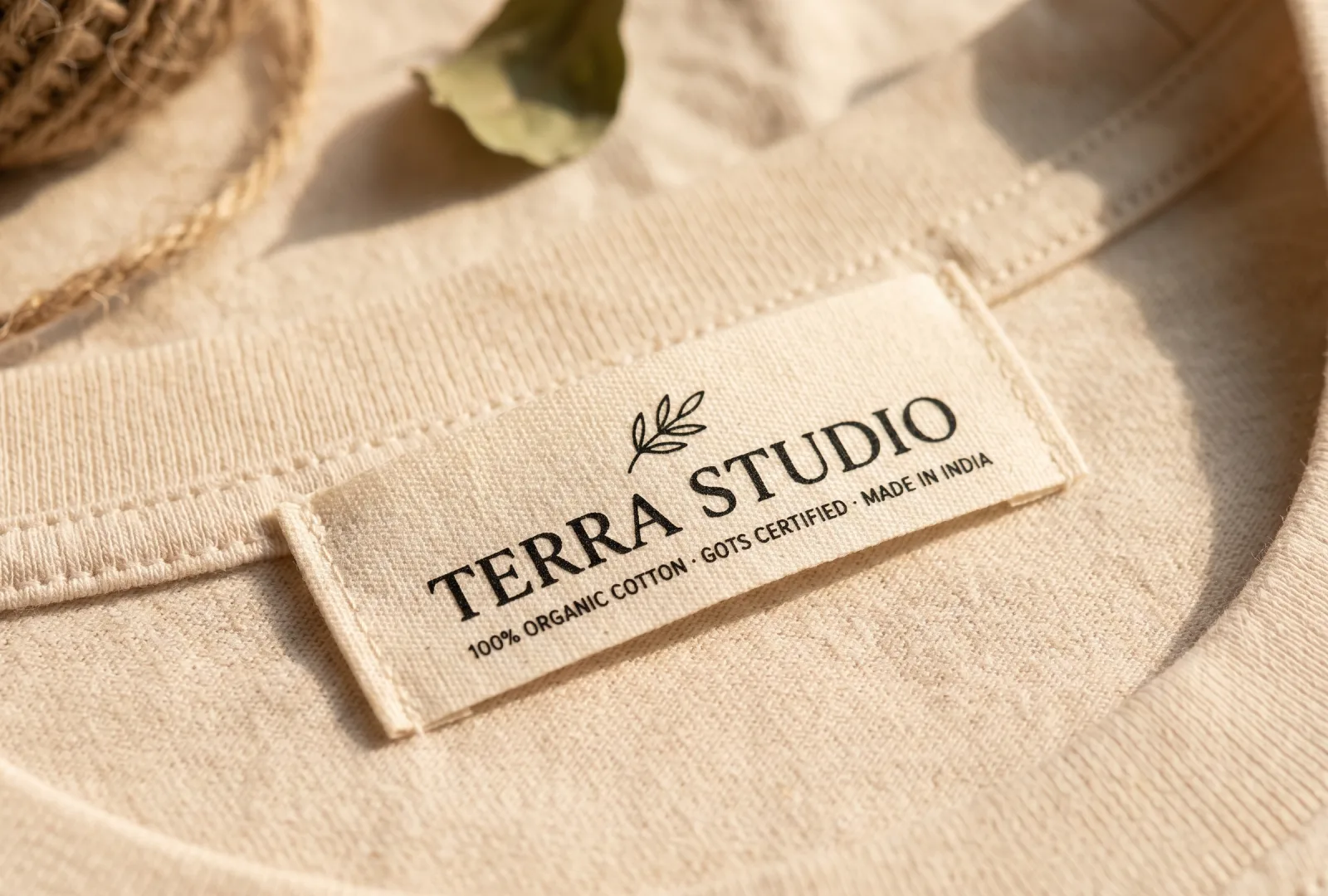
A GOTS-certified organic cotton t-shirt with a polyester satin label is a contradiction the customer can feel. Sustainable Indian fashion brands are growing fast — but most still source labels from generic suppliers who only offer synthetic ribbon. Here's how to spec eco-friendly labels that match your garment story.
What "eco-friendly label" actually means
The term gets thrown around loosely. There are three real dimensions, and a serious eco brand should think about all three:
- Base material — cotton tape (biodegradable) vs polyester satin (not). Cotton can be conventional, organic, or organic + GOTS-certified.
- Ink / thread — soy-based or water-based pigment ink for printing, OEKO-TEX certified threads for weaving. Avoid plastisol on eco labels.
- End-of-life — a cotton label with soy ink composts. A polyester label with plastisol does not.
If your brand uses "sustainable" or "eco" in its messaging, the label is the most visible proof point. Customers in this segment notice.
The cotton label options ranked by sustainability
The top tier is the cleanest claim. Undyed cotton looks natural off-white, prints accept any colour, and the entire label biodegrades. Costs 20–30% more than conventional cotton, but it's the strongest visual signal of sustainability.
GOTS, OCS, OEKO-TEX — which certification matters?
Three certifications come up most often for eco fashion in India. Each means something different:
- GOTS (Global Organic Textile Standard) — covers the entire supply chain from fibre to finished product. If you want to put the GOTS logo on your hangtag or label, every step (cotton farm, spinner, weaver, dyer, printer, label maker) must be certified. This is the hardest and most credible certification.
- OCS (Organic Content Standard) — only verifies the organic fibre content (≥95% for "Organic", 5–95% for "Made with Organic"). Easier to obtain than GOTS, useful for blends.
- OEKO-TEX Standard 100 — tests the finished label for harmful substances. Doesn't certify organic origin, but proves the label is skin-safe. Most premium label suppliers can offer this.
For most Indian D2C eco-brands, OEKO-TEX is the practical starting point. GOTS labels are required only if you want the GOTS logo on your finished garment label.
Pricing tiers for cotton & organic labels
Indicative per-piece pricing for a 30×50mm printed cotton label (brand mark on front, care symbols on back, 2 colours):
Cost adders to plan for:
- Soy ink instead of plastisol — +10–15%
- Organic cotton (vs conventional) — +20–30%
- GOTS-certified supply chain — +15–20% on top, plus 5–7 extra days lead time
- Undyed natural cotton — same price as conventional cotton (no dye step)
A fully organic + soy-ink + OEKO-TEX label at 500 pieces lands at ₹4–5 per piece — roughly the price of a basic woven satin label. The cost gap between eco and conventional is much smaller than founders assume.
Picking the right label format for cotton garments
Different cotton garment types need different label approaches:
- T-shirts / loungewear (jersey cotton) — tagless heat-press for the brand, or a soft sewn cotton label with end-fold. Avoid stiff woven satin against bare-skin contact areas.
- Shirts (woven cotton) — sewn cotton or printed satin label at the neck, paired with a printed care label at the side seam.
- Knitwear / sweaters — small woven cotton label at the inside back neck. Heat-press doesn't bond well to knits.
- Workwear / outerwear — durable cotton-blend label survives industrial washing better than 100% cotton. A small trade-off vs full eco purity.
- Babywear — undyed organic cotton, no print on skin-facing side. OEKO-TEX class 1 (intended for babies under 36 months).
Common eco-label mistakes: printing "100% organic cotton" on a label that's actually conventional cotton (greenwashing — bad for trust and increasingly illegal in EU markets); using plastisol ink on cotton tape (kills the biodegradability claim); going through a non-certified middleman while paying GOTS prices.
What to send for an eco-label quote
- Brand logo — vector preferred (AI / EPS / PDF / SVG).
- Certifications you need on the label — GOTS / OCS / OEKO-TEX / "none, just want cotton material".
- Garment type — t-shirt / shirt / babywear / loungewear etc. Drives format.
- Care symbols — wash temp, dry symbol, bleach yes/no, iron temp.
- Fabric composition — 100% organic cotton / 95% cotton 5% spandex / etc. Goes onto the care label by law.
- Quantity — even rough. 100 / 500 / 1000.
Lead time for eco labels
Logo + cert level + garment type
Material, ink, finish · 2–4h
Digital image + (optional) physical sample
10–14 days for standard; +5–7 if GOTS-certified
GOTS-certified runs take longer because the certified chain has fewer slots and pre-booking is common. Plan 21 days ahead for GOTS; 10–14 for standard organic cotton.
The label as part of the brand story
Eco-fashion customers care about how the garment was made, not just what it looks like. Most labels say nothing — a logo, a size, a wash code. An eco-brand label has a chance to say more: "100% GOTS-certified organic cotton. Soy ink. Compostable. Made in India." Four lines, on a 30×50mm undyed cotton label, costs ₹4–5 at 500 pieces.
That label gets photographed, shared, screenshotted. It's the cheapest piece of brand storytelling you'll ever ship.
Ready to spec sustainable labels? Browse cotton labels and care labels on our product pages, or see labels for D2C fashion brands and labels for yoga & activewear for segment examples. For pricing, use the price calculator or send a brief via quick quote.