
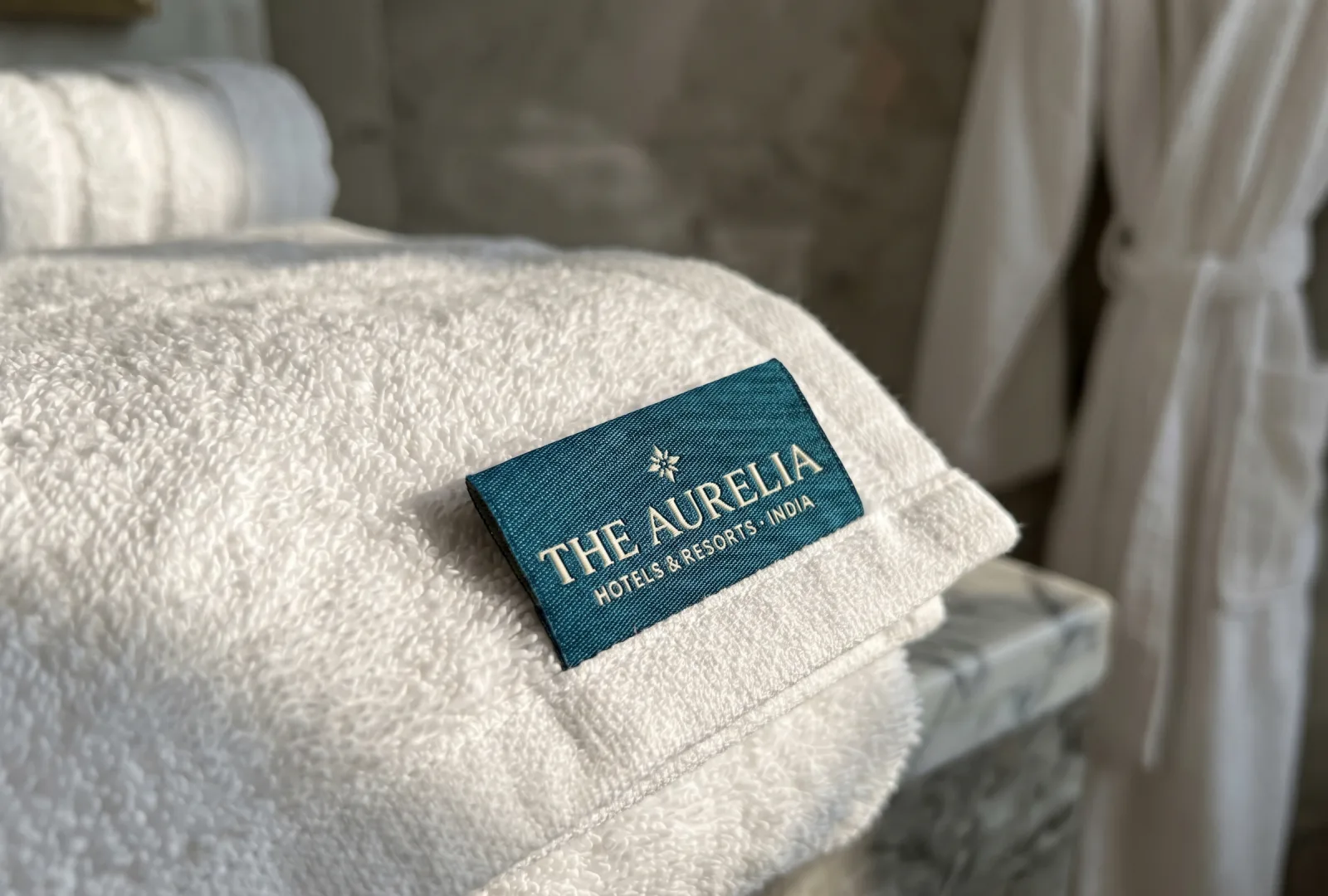
If you operate a hotel, resort or hospitality property, you've probably noticed: the linen labels you ordered last year have started disintegrating. Some are missing entirely. The brand colour has drifted. Customer-facing fabric — towels, robes, bedlinen — looks third-hand. The cause isn't the supplier ripping you off. It's a fundamental mismatch between standard labels and what hospitality laundry actually does to them.
What hospitality laundry actually does to labels
A typical hotel wash uses chlorine bleach, high-pH detergents, oxygen bleach and soaping agents — daily, with high-spin extraction and 80–100°C tumble drying. A standard satin label rated for "100 wash cycles" hits that limit in 100 days at this frequency. By month 6, it's gone.
Why standard labels fail
- Polyester satin — degrades from chlorine bleach. Threads weaken; the label frays at the edges within months.
- Standard dye — chlorine strips colour. Your brand teal turns sky-blue, then off-white.
- Heat-transfer prints — adhesive softens at 90°C. The print peels in chunks.
- Stitching thread — domestic-grade polyester thread breaks down. The label simply detaches.
The label material, the dye, the print medium and even the stitching thread have to be upgraded for hospitality use. Most suppliers don't do all four — they sell domestic-spec labels with hotel-spec branding.
The engineering fix
An industrial-laundry-safe label needs four upgrades, not one:
1. Industrial-grade weave base
High-density damask weave on bleach-resistant polyester base. Damask's tighter thread structure resists bleach penetration; the high density means chemical attack happens slower and more uniformly. Visible degradation pushes from "6 months" to "5+ years."
2. Bleach-stable dye recipe
Standard dye batches optimise for cost and colour vibrancy. Bleach-stable recipes use dyes engineered to bond at the molecular level with bleach-resistant fibres — they cost 15–25% more but hold colour through chlorine exposure indefinitely.
3. Industrial stitching thread
The label only stays on the linen as long as the thread holds. Use polyester-core thread rated for 90°C wash. Cheap thread is the silent failure point most operators miss.
4. Standardised laundry symbols
The care label printed on every linen piece needs symbols that match your specific laundry program. Outsourced laundries follow what's printed; if the symbols say "wash 30°C," they ignore your operational reality and you get inconsistent results.
Brand consistency across restocks
The second silent killer: every restock looking different.
If you've ordered linen labels four times from four suppliers, you've probably noticed four slightly different shades of your brand colour. Some teals, some teal-greys, some teal-blues. Guests notice in unconscious ways — your property starts looking subtly off-brand.
The fix is operational, not technical: pick a supplier that locks the dye recipe to your account. Pantone match on the first order, store the recipe, every restock pulls from it. We do this; it's cheap to maintain, expensive to skip.
If you've already locked your spec elsewhere and just need someone to match it for restocks: send the existing label spec, target Pantone, and one of the existing labels for reference. We can replicate to match your historical batches.
What to spec for hospitality
- Linen labels — high-density damask, bleach-stable dye, industrial polyester thread, 30×40mm typical, end-fold or mitre-fold.
- Towel labels — same as linen, often slightly smaller (25×30mm) so they sit cleanly in the corner.
- Uniform labels — softer satin under collars (staff comfort matters during 8-hour shifts), but still bleach-resistant.
- Care labels for outsourced laundry — symbols matched to your specific laundry program, not generic templates.
Cost reality
For multi-property chains
If you operate 3+ properties under one brand, lock the recipe centrally and pull restocks against the same spec for all properties. Otherwise the third property quietly drifts off-brand within 18 months. Standing 6-month restock slots are cheaper than emergency reorders.