
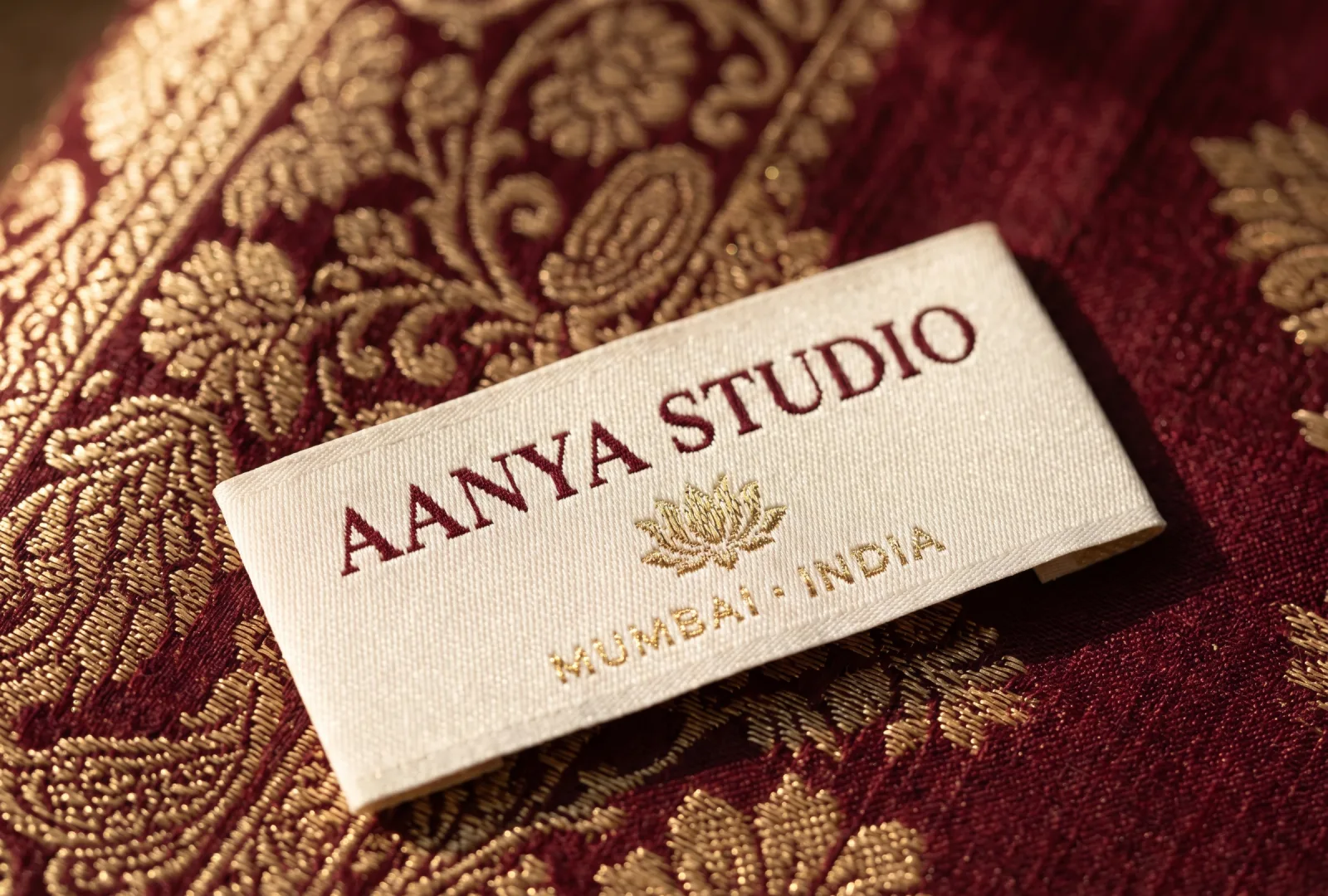
Indian boutique shoppers feel a label before they read it. A heavy gold-thread damask tab inside a ₹15,000 lehenga reads premium. A flimsy printed sticker on the same garment reads "knock-off." If you're building a saree, lehenga or kurta brand, the label spec is part of your price tier — not an afterthought.
What "boutique-grade" actually means
Mass-market kurta brands use polyester satin labels with 2–3 thread colours. Boutique brands need three things mass brands don't: heavier ribbon weight (damask, not flat satin), a metallic accent thread (gold or silver lurex), and a fold that sits flat under the neckline. The combined cost difference per garment is ₹15–25 — trivial against a ₹3,000+ price tier, but the perceived value lift is large.
If your retail price is below ₹1,500, treat boutique-grade labels as optional. Above ₹3,000, treat them as table stakes.
Where each label goes on a boutique garment
Boutique garments use 3–4 label touchpoints, each with a different job:
The neck and hem tags are the brand layer. The care label is the legal layer (fabric content, wash). The hangtag is the retail layer — what the customer sees before unwrapping.
Picking weave and thread for ethnic fabrics
Different garment fabrics need different label fabrics. The wrong pairing scratches the wearer or looks cheap against the cloth.
- Silk sarees / pure silk lehengas — Mitre-fold satin or damask, soft hand-feel, gold or maroon thread on cream. Never a stiff polyester satin — it scratches against silk.
- Banarasi / brocade lehengas — Damask weave with metallic thread reads as a match for the brocade. A flat satin label looks plain against the brocade pattern.
- Cotton kurtas / chikan / khadi — Cotton or satin label with khaki/maroon/indigo thread. Soft hand-feel. Skip lurex — it clashes with the fabric's earthy texture.
- Net / georgette / chiffon — Centre-fold satin tab so the label edge is fully tucked. The fabric is too sheer for a stiff end-fold.
- Embroidered / mirror-work pieces — Small woven tab on the side seam, not the neck. The neckline is already busy with embroidery.
Realistic pricing for boutique label specs
Indicative per-piece pricing for a boutique-grade neck label (30×40mm damask woven, gold lurex thread, end-fold, 6 thread colours):
Add a satin hem tag (₹2–3), a printed care label (₹1–2) and a paper hangtag with string-tie (₹6–12) — the full label set lands between ₹17–27 per garment at 100 pieces. At a ₹3,000+ retail price, that's under 1% of cost.
MOQ for boutique brands
Most boutique brands stitch in small batches (10–50 pieces per design). You don't need labels per design — you need labels per brand, used across designs.
Order one brand label in 300–500 pieces; stitch it into every SKU you produce for the next 4–8 months. Order care labels separately per fabric type (silk, cotton, georgette) since wash symbols vary.
The hangtag question
For boutique pieces above ₹2,500, a hangtag is non-negotiable. Three options ranked by perceived value:
- Printed paper hangtag with string-tie — ₹6–12 per piece. Best value-for-perception. Use 300 GSM kraft or matte art paper, gold-foiled brand mark on front, care + price + size on back.
- Fabric (satin / cotton) hangtag with bead — ₹14–22 per piece. Premium feel; takes another 7 days to produce. Use for ₹8,000+ pieces.
- Letterpress / foil-stamped paper hangtag — ₹18–30 per piece. Best-in-class. Couture-only price tier.
The string-tie matters too — twisted cotton beats nylon. The hangtag is the first physical touchpoint after the box opens.
What to send for a quote
- Brand logo — vector preferred (AI / EPS / PDF / SVG). 300+ DPI PNG works.
- Garment type + fabric — saree / lehenga / kurta + silk / cotton / georgette. Drives weave and fold choice.
- Retail price tier — under ₹1,500 / ₹1,500–3,000 / ₹3,000–8,000 / ₹8,000+. Sets the spec ceiling.
- Where it goes — neck, hem, side seam, hangtag. Each needs different dimensions.
- Quantity — even rough. 100 / 300 / 500 / 1000.
- Thread colours — pick from a Pantone reference or send swatches. Gold / silver / maroon / cream most common for ethnic.
Avoid these boutique label mistakes: a generic printed sticker on a ₹10,000 lehenga; a stiff polyester satin label scratching against silk; a 5-language care label crowding out the brand mark; a hangtag with the retail price printed in marker.
Order sequence for first-time boutique orders
Logo + price tier + garment type
Weave, thread, fold, size · 2h
Image preview before approval · same day
7–10 days production, 1–3 days transit
Total: ~10–14 days from first message to receiving labels. Restock orders run in 7–10 days because spec is already locked.
The compounding return
A boutique customer who unboxes a saree with a gold-thread woven neck label, a satin hem tab, a thoughtful care guide and a letterpress hangtag will remember the brand. They'll post the unboxing on Instagram. They'll come back for the next lehenga. The label spec costs ₹20–30 per garment. The repeat order it earns is worth thousands.
This is the highest-leverage ₹20 spend in a boutique line item — and most founders skip it.
Ready to spec your boutique labels? See our full boutique & ethnic wear labels page for portfolio examples, or jump to the woven labels and care labels product pages. For pricing, use the price calculator or send a brief via quick quote.