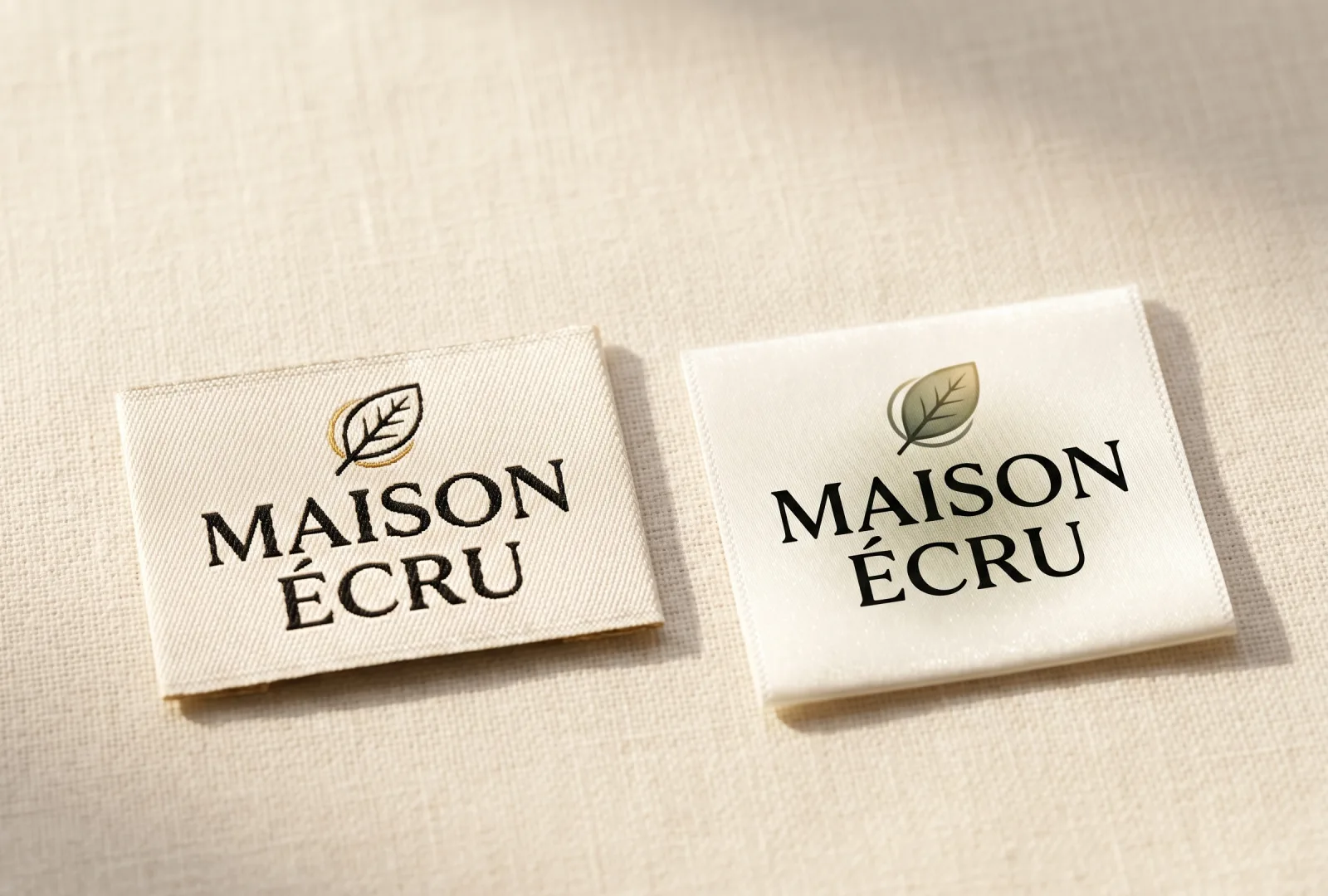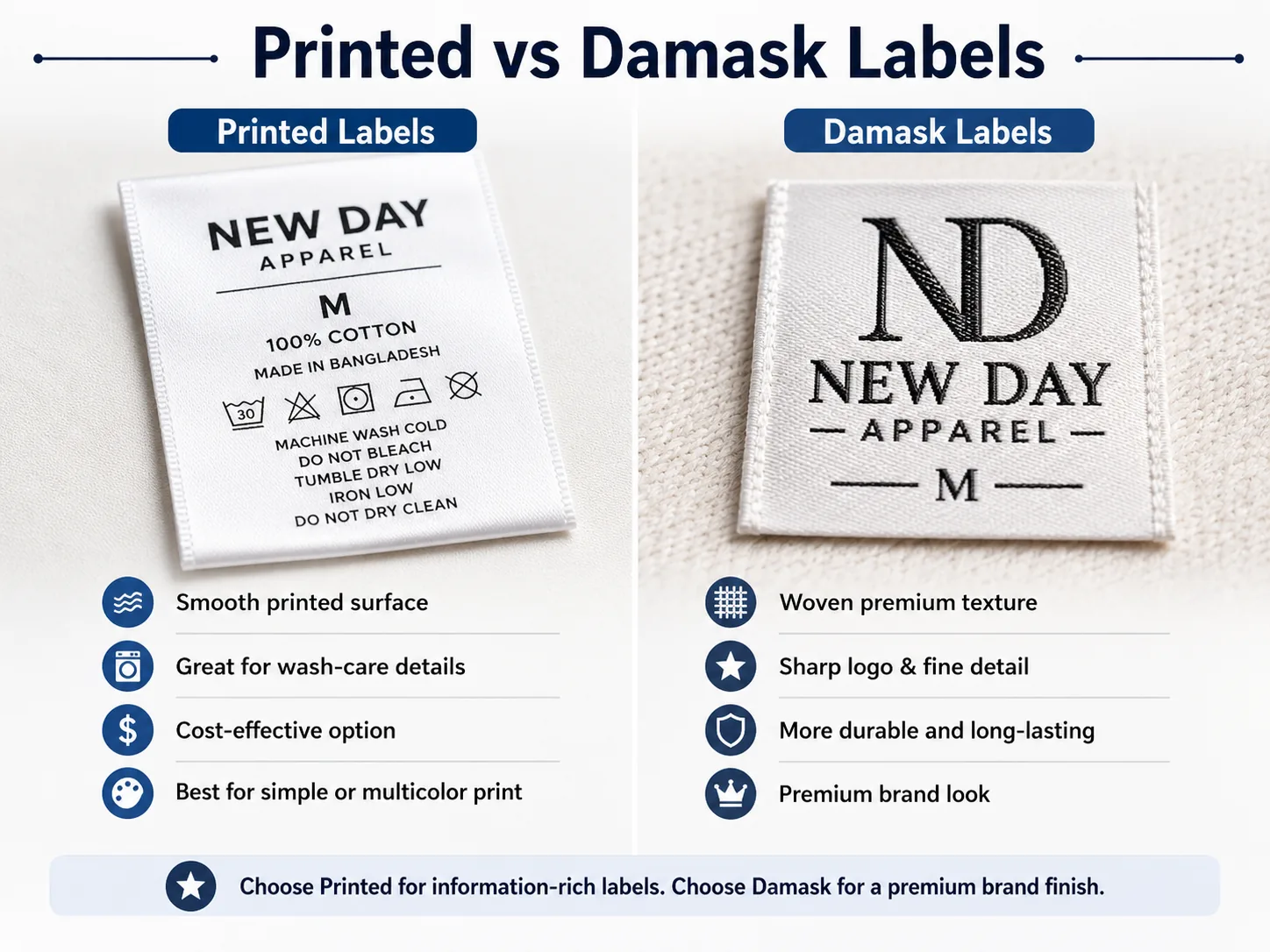
"Printed" is a category. "Damask" is a tier. So the printed-vs-damask comparison isn't quite apples to apples — but it's the question buyers ask because the two are often the finalists when they're choosing between vibrant full-colour artwork and a heritage woven feel.
This guide compares the printed label family (satin and taffeta substrates) against the premium woven tier (damask). By the end you'll know when full-colour print wins, when heritage damask is the only honest choice, and how to use both on the same garment without spending twice.
At a glance — printed vs damask
The decision splits along two axes: how colour-rich is the artwork, and how much premium-feel do you need to project.
What is a printed label (satin or taffeta)?
"Printed label" covers any clothing label where the artwork is applied via printing — usually dye sublimation — onto a polyester substrate. The two main substrates are satin (glossy, soft, premium contemporary) and taffeta (matte, sharp, export-grade). Both accept full CMYK including gradients.
- Substrate: polyester satin or nylon/polyester taffeta
- Process: dye sublimation, sometimes screen print
- Colour: full CMYK + gradients + photo detail
- Cost: ₹0.40–2 per piece at 1,000+ pieces
- Lead time: 5–7 days
What is a damask label?
Damask is the highest-density woven label — 10,000–12,000+ stitches per square inch using fine polyester thread in a satin-weave structure. Colour is structural (woven into the fibre), permanent, and the result is a silky finish with intricate detail.
- Substrate: polyester thread woven on jacquard loom
- Process: high-density jacquard weaving, satin weave structure
- Colour: 1–8 distinct thread colours; no gradients
- Cost: ₹1.70–8 per piece across MOQ range
- Lead time: 10–14 days
Head-to-head — feature comparison
- Full-colour artwork with gradients
- 3–5× cheaper than damask
- Faster turnaround (5–7 days)
- Handles photographic detail
- Works on care labels with dense ISO symbols
- Ink can fade over time (low-quality process)
- Doesn't read as "heritage" or "crafted"
- Less differentiation from mass-market printing
- Surface ink shows abrasion on rough fabric blends
- Permanent colour — woven into the thread
- Heritage / crafted feel — luxury default
- Silky finish, intricate detail
- Reads "made to last" at the rack
- Best at sub-15-mm-tall fine type
- 3–5× more expensive than printed
- Limited to 1–8 thread colours
- No gradients, no photo detail
- Longer lead time
- Wasted on simple wordmark-only artwork
Cost ladder — printed vs damask
Representative pricing for a 25 × 40 mm centre-fold label, 2026:
Damask costs roughly 3–5× more than printed. The gap narrows at scale but the absolute rupee premium remains meaningful — ₹1.30 per piece at 10,000 units is ₹13,000 per 10K-batch.
By garment type — which to pick
- D2C contemporary fashion
- Kidswear with bright artwork
- Activewear, athleisure, performance
- Care labels (any garment)
- Sub-₹3,000 retail price points
- Heritage / luxury fashion (₹5,000+ retail)
- Formal shirts, suits, blazers
- Premium denim & designer outerwear
- Saree blouse & bridal-wear
- Brands where "made to last" is the promise
Decision matrix — 30-second pick
Printed. At sub-mid-market price, the 3–5× damask cost is hard to justify on margin.
Printed. Damask can't reproduce gradients — only printed methods can.
Damask. The crafted woven feel is structural to the brand story.
Damask. Structural colour never fades; ink prints eventually do under repeated wash.
Pro tips before you order
The smart hybrid: damask for the brand, printed for the care label. Damask at the visible neck (heritage feel) + taffeta-printed care label at the side seam (ISO-compliant, multilingual). You spend a bit more on the visible piece and save on the hidden piece.
If your artwork is simple wordmark-only, damask is overkill. The fine-detail advantage of damask is wasted on plain type. Standard woven gives 80% of damask's quality at half the cost — and printed satin can match damask's premium feel via sublimation on a glossy face.
Quick start: WhatsApp us your artwork and target retail price. We'll send a damask sample and a printed sample of the same artwork — you can hold them side-by-side. Message Labelwala or use the quote form.
The short answer
Printed for contemporary, colour-rich, cost-sensitive fashion. Damask for heritage, formal, luxury fashion above ₹3,000 retail. Mix them on the same garment if you want premium brand-label feel without paying damask premiums on every label position. The choice is rarely "either-or" — it's "which goes where."