
If you sell on Myntra, Ajio or Amazon, the wrong care label gets your shipment rejected at QC. If you sell direct, it gets your garment ruined in someone's washing machine and shows up as a 1-star review. Either way, generic care-label templates are a quiet killer. Here's a fabric-by-fabric breakdown of what to put on the label.
The five symbol families
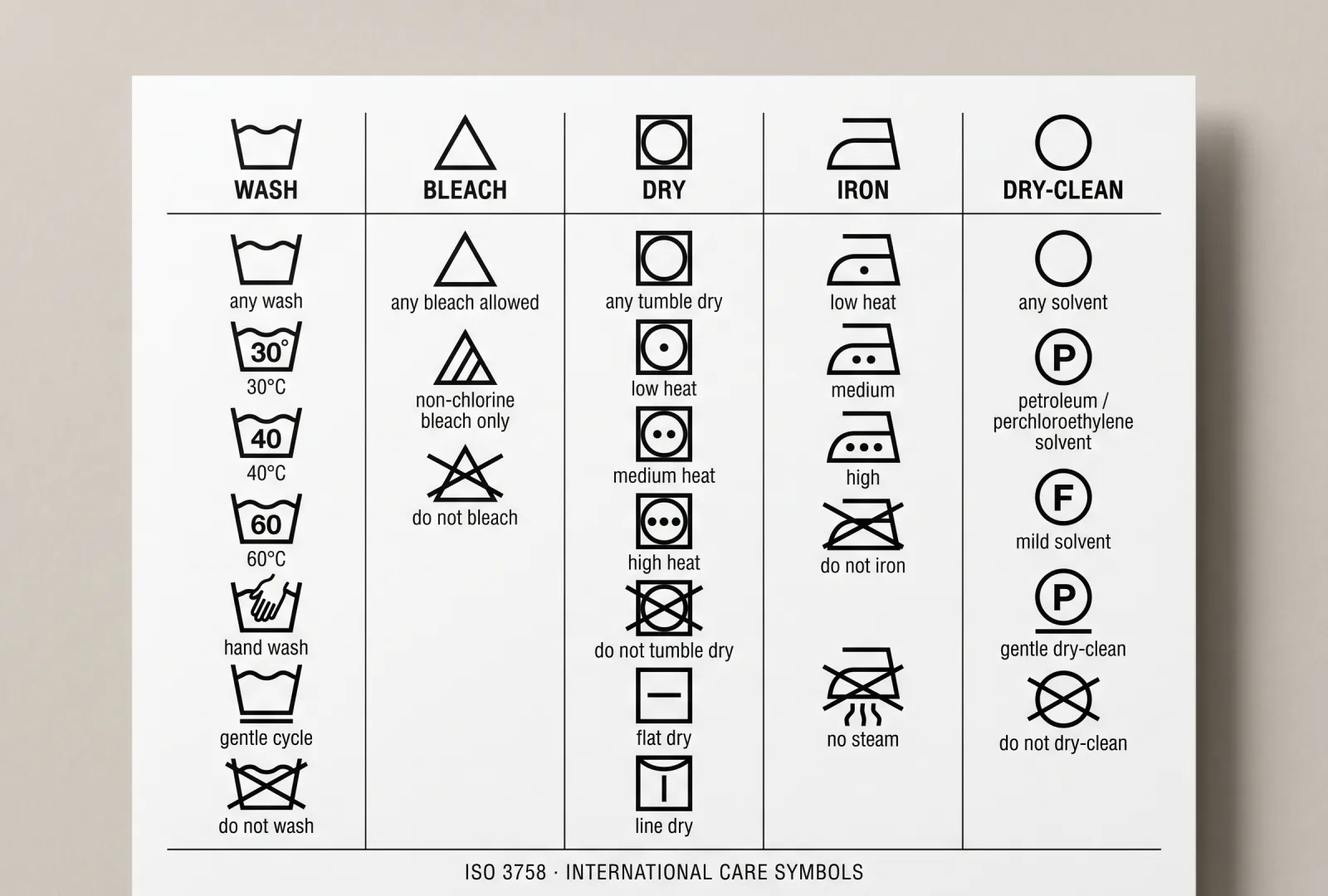
Every care label uses the ISO 3758 standard. There are five symbol groups, each with multiple variants:
- Wash — bucket icon. Variants for hand wash, machine wash, max temperature, gentle/normal cycle, do not wash.
- Bleach — triangle. Variants for any bleach, non-chlorine only, do not bleach.
- Tumble dry — circle inside square. Variants for any heat, low heat, do not tumble dry, line dry, flat dry.
- Iron — iron icon. Variants for high/medium/low heat, do not iron, no steam.
- Dry-clean — circle. Variants for any solvent, mild solvent only, do not dry-clean.
Most garments need 4 of these (skip dry-clean for cottons, skip iron for synthetics). The trick is matching variants to your specific fabric.
Cotton (100% or majority cotton)
Cotton is forgiving — most templates are correct here. Watch out for dyed cotton: switch "any bleach" to "non-chlorine only" or you'll get pink-spotted whites in customer wash.
Polyester & synthetic blends
This is where generic templates fail most often — most list "machine wash + iron OK," which is wrong for polyester. Customers ruin synthetic garments by ironing them.
Stretch fabrics (spandex, recycled poly, moisture-wicking)
If you sell yoga, activewear or swimwear, never let "tumble dry" appear on the label. Heat destroys spandex permanently — and customers do this routinely.
Silk, georgette, chiffon & banarasi
Bridal and ethnic wear should default to "dry-clean only" unless genuinely washable. Returning a ₹2L lehenga because it bled in domestic wash is the costliest mistake on this list.
Wool & cashmere
Linen
What else has to be on the label
Beyond symbols, retail-compliant care labels also need:
- Fibre composition — e.g. "100% Cotton" or "65% Cotton, 35% Polyester". Required by Indian and international retail standards.
- Country of origin — "Made in India" (also "Fabriqué en Inde" for export-ready).
- Size — sometimes on a separate size tab, sometimes bundled into the care label.
- Care instructions in text — symbols are mandatory in some markets; in others, text is acceptable. Use both for safety.
Quick test before you order bulk: wash one of your sample garments per the symbols you're about to print. If the garment survives, ship the label. If it doesn't, change the symbols — not the fabric.
Common mistakes to avoid
- Generic "machine wash cold + iron OK" template on synthetic activewear.
- "Any bleach" on dyed garments.
- "Tumble dry" on stretch fabrics.
- Missing "do not iron" on printed graphics — heat melts most prints.
- Origin in only one language for export shipments.