
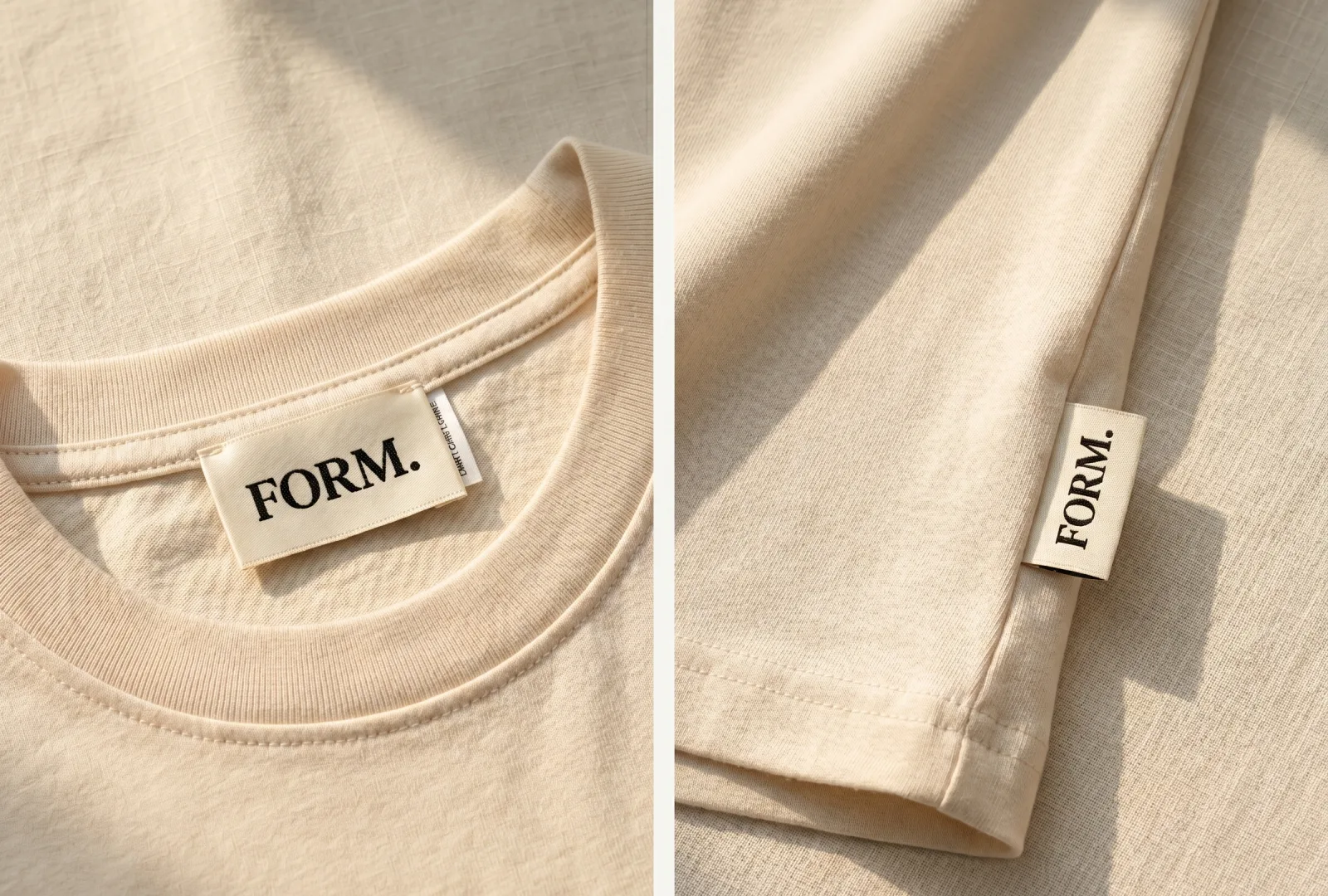
Walk into any clothing factory and you'll hear neck labels called "main labels," hem tags called "hem flags," and size tabs called "side seams." The names overlap and contradict each other depending on who you ask. Here's a clean reference for where each label actually belongs and what each one is for.
Neck label
Inside the collar — your brand mark, the first thing the customer sees and feels.
Care label
Stitched behind the neck label or into the side seam — wash, fibre, origin.
Side-seam size tab
Small printed XS/S/M/L tab — visible at the rack without lifting the collar.
Hem tag
Visible on the outside hem — branding when the tee is worn loose.
Neck labels (the brand mark)
The label stitched into the inside of the collar — the first thing your customer sees and feels. Its only job is to carry your brand identity: your logo, sometimes a tagline, sometimes country of origin.
Most common spec: 30×15mm to 50×25mm woven satin or damask, end-fold or centre-fold, stitched into the inside of the collar facing.
What goes on it: brand logo. That's it. Don't crowd a neck label with size, care, or composition — those go on separate labels behind it.
Care labels (the rules)
Stitched behind the neck label or into the side seam. Carries care symbols, fibre composition and country of origin. Required for retail and marketplace compliance — see our care label symbols guide.
Most common spec: printed satin or cotton tape, 25–35mm wide, multi-line layout to fit symbols + composition + origin.
Hem tags (the visible flag)
This is where it gets confusing. A hem tag (also called a "hem flag" or "design tag") is a folded label visible on the outside of the hem — usually on a tee, hoodie, or sweatshirt. The fold creates a small fabric tab that sticks out from the seam.
It's different from a neck label because it's external — visible to anyone, not just the wearer. Streetwear and skate brands love them; they double as branding when the garment is worn loose or untucked.
Most common spec: 25×40mm woven damask or satin, end-fold (single-fold), stitched into the side hem of a tee or sweatshirt.
Side-seam size tabs
Small printed labels stitched into the side seam, usually marking XS / S / M / L / XL. They exist because customers sort through racks holding the side seam, not the collar — sizes need to be visible quickly.
Most common spec: 15×30mm printed satin or taffeta, single-letter or two-letter size markers, stitched 5–10cm above the bottom hem on the side seam.
Hangtags (the unboxing)
The paper or fabric tag that hangs from a string, attached to the garment in retail. Comes off when the customer wears it. Carries brand story, price, SKU, washing tip — anything you want the customer to see before they wear it.
Most common spec: printed paper, 50×80mm to 60×100mm, looped through a buttonhole or stitched seam with a small string and seal.
Which combination should you start with?
For a typical D2C fashion drop, here's what most founders actually need:
- Neck label — woven satin, brand logo only.
- Care label — printed satin, wash symbols + fibre + origin.
- Hangtag — printed paper, brand colours + price + thank-you note.
That's it. Add side-seam size tabs later when you scale past 3 sizes. Add hem tags when your aesthetic genuinely calls for visible branding (streetwear / skate / unisex basics).
The trap: first-time founders often try to put everything on one combined label — brand + care + size + origin. It's cheaper and tidier in artwork, but it crowds the design and creates an itchy stack. Use 2–3 separate labels instead.
Other placements you'll occasionally see
- Sleeve labels — outer label on jacket sleeves, common in technical wear and outerwear.
- Pocket labels — woven labels stitched into the inside of a back pocket on jeans.
- Waistband labels — for trousers and jeans, often woven jacquard for premium feel.
- Chest patches — separate piece, see woven patches.