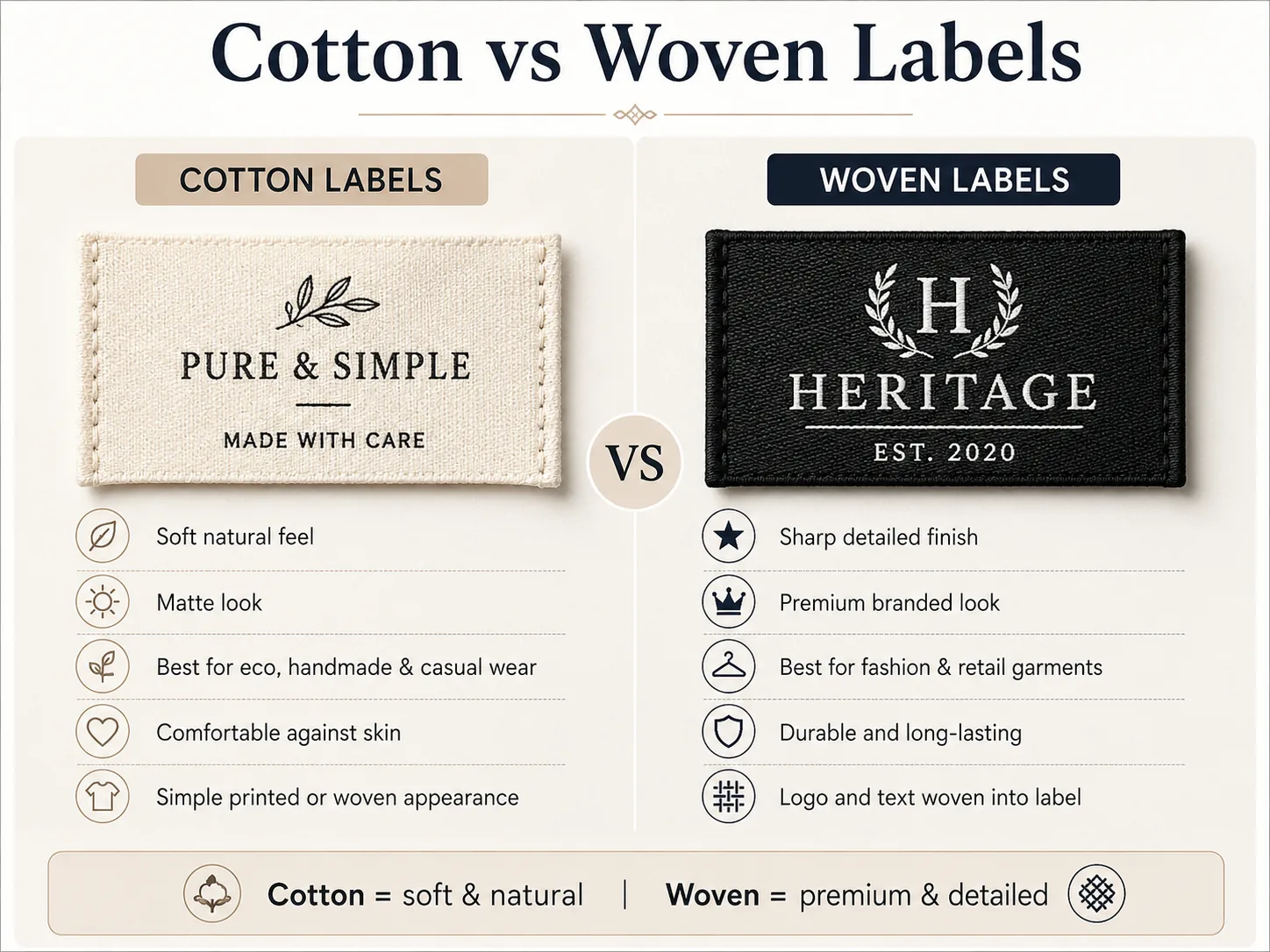
"Cotton label" and "woven label" sound like different categories, but technically a cotton label IS a woven label — it’s just woven on cotton thread instead of polyester. That subtle difference in fibre choice changes how the label looks, feels, prices and ages. It also decides whether the label aligns with — or undermines — your sustainability story.
This guide compares the two side-by-side: same loom, different thread. By the end you’ll know which fibre belongs on which garment, and how the cost difference shapes the decision at every MOQ.
At a glance — cotton vs polyester woven
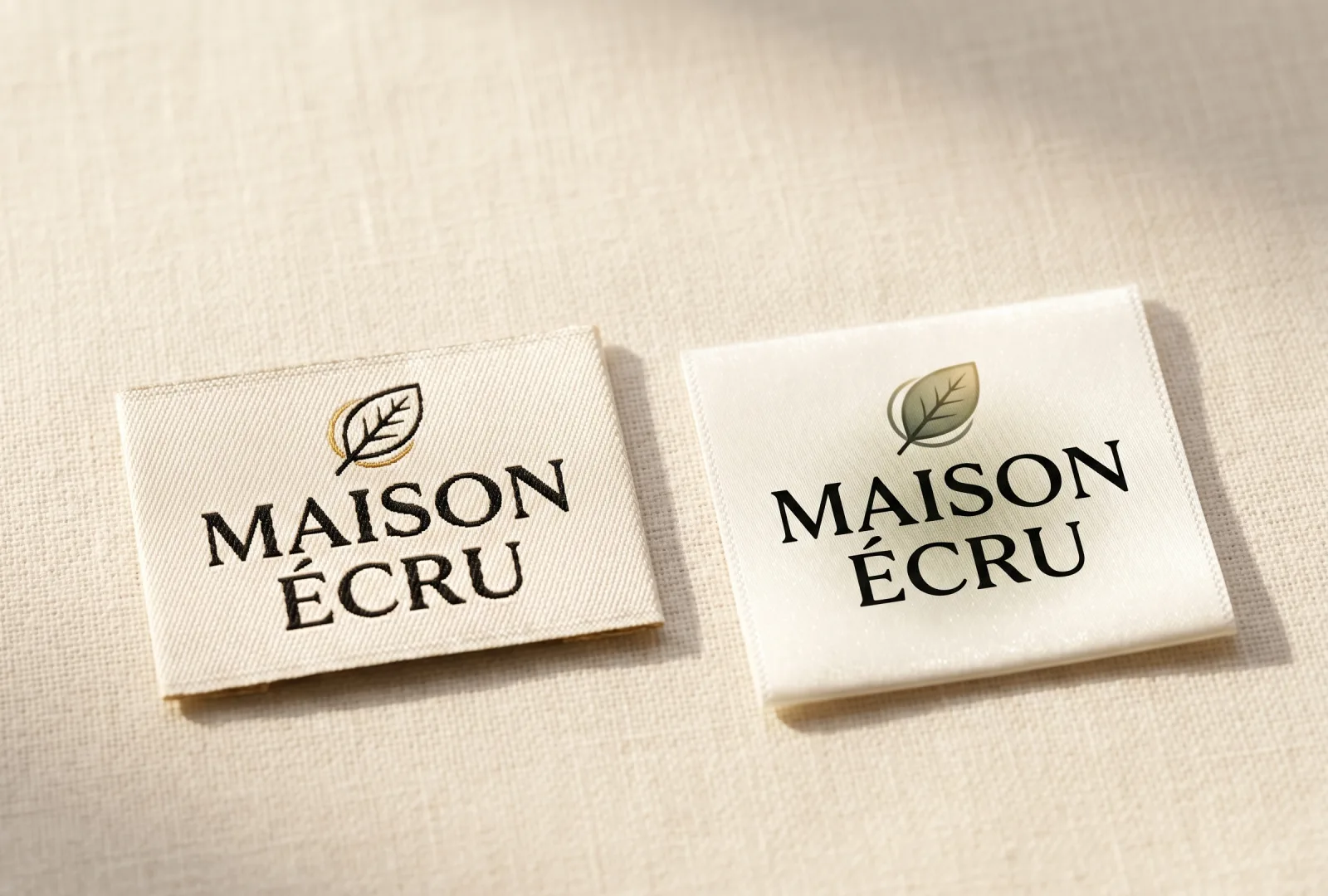
Both are made on the same jacquard looms. The only difference is the warp/weft thread material — and that single substitution changes everything from feel to ecology to price.
What is a cotton woven label?
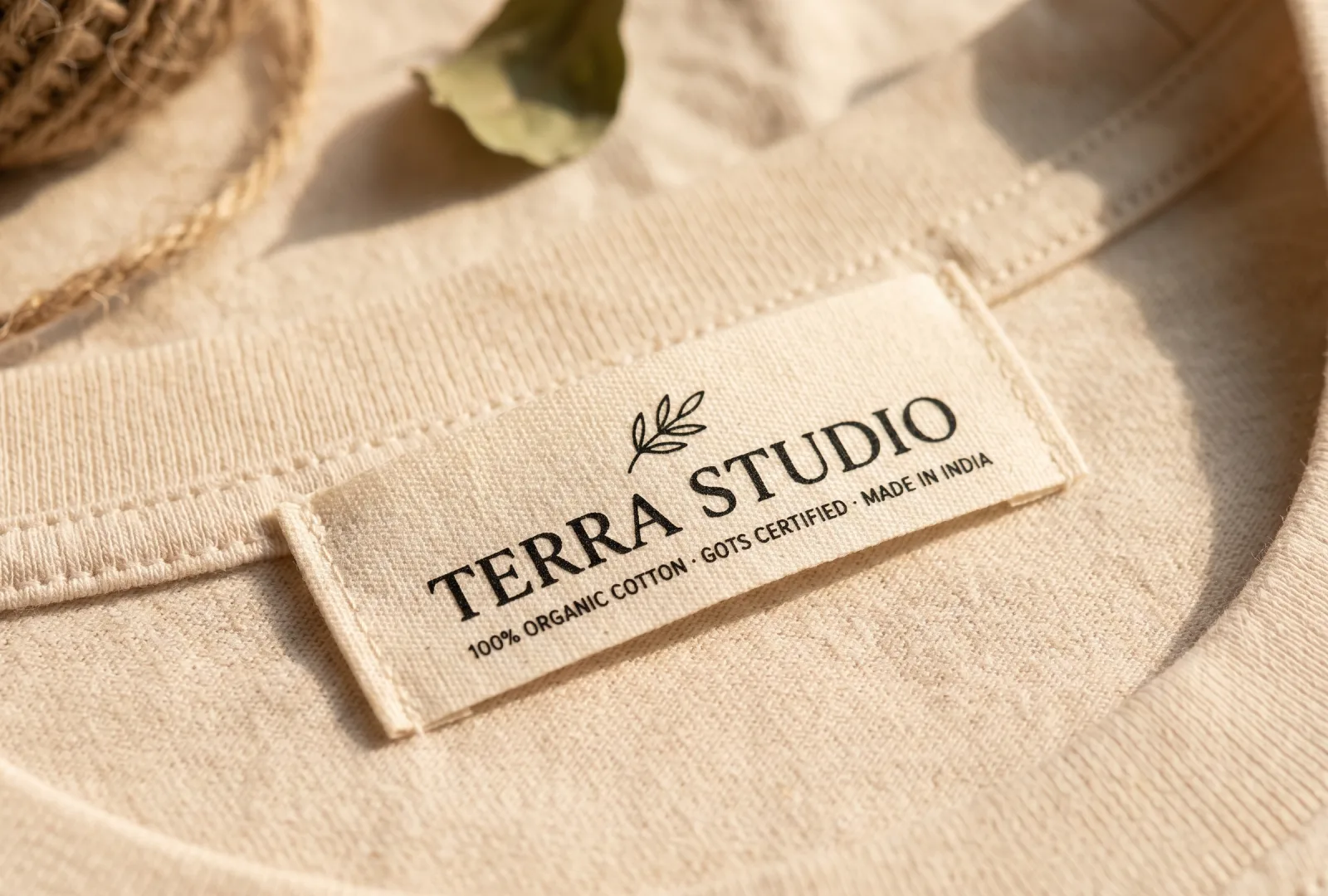
Cotton woven labels are produced on jacquard looms using combed cotton thread instead of polyester. The artwork is woven into the fabric structure exactly like a polyester woven label — colours are structural, not printed. The end result is a label with natural-fibre warmth, slight matte finish, and biodegradable lifecycle.
- Thread: 100% combed cotton (or GOTS-certified organic cotton)
- Process: jacquard weaving, same machines as polyester woven
- Colour: 1–6 distinct thread colours; no gradients
- Lifecycle: biodegradable, compostable
- Feel: matte, warm, paper-like; softer than polyester woven
What is a polyester woven label?
Standard woven labels use polyester thread on the same jacquard looms. Polyester is cheaper, stronger, more colour-fast and capable of finer thread detail than cotton. Standard density (~6,000 stitches/sq inch) up to damask (~12,000) produces increasingly intricate detail.
- Thread: 100% polyester (rarely cotton-poly blend)
- Process: jacquard weaving
- Colour: 1–8 distinct thread colours; finer detail possible
- Lifecycle: not biodegradable; recyclable
- Feel: smooth, slight sheen; firmer hand than cotton
Head-to-head — feature comparison
- Biodegradable — natural fibre lifecycle
- GOTS / Oeko-Tex certifications available
- Matte natural look — artisanal, handcrafted feel
- Aligns with organic / slow-fashion brands
- Softer, warmer hand against skin
- 60–80% more expensive than polyester woven
- Coarser thread limits fine-detail weaving
- Shrinks 3–5% on first wash without pre-shrinking
- Colours less saturated than polyester
- Higher MOQ on organic certified cotton (300+)
- Sharpest detail at high-density weave
- Wider colour range and saturation
- Cheapest at every MOQ tier
- Damask option for ultra-premium feel
- Survives industrial laundry without shrinking
- Synthetic — contradicts eco-fashion claims
- Not biodegradable, lands in landfill
- Can feel scratchy at low-density weave
- No GOTS certification possible
- Less "artisanal" reading
Cost ladder — cotton vs polyester woven
Representative pricing for a 25 × 40 mm centre-fold woven neck label, 2026:
Cotton runs ~60–80% more than polyester woven. The premium narrows slightly at higher volumes but never disappears — cotton thread costs more per kg, weaves slower, and demands more skill from the loom operator.
By garment type — which to pick
- Organic / GOTS-certified clothing brands
- Hand-loom / artisan / slow-fashion brands
- Hemp, linen, organic-cotton apparel
- Baby clothing (chemical-free skin contact)
- Sustainability-led premium fashion
- Formal shirts & suits
- Denim & outerwear
- Mass-market fashion at scale
- School blazer crests & uniforms
- Sportswear & jersey labels
Decision matrix — 30-second pick
Cotton. Polyester labels inside organic garments are a credibility leak — buyers notice.
Polyester. Cotton thread is coarser; intricate detail and tight type weave better in polyester.
Polyester. Cotton can’t hit that price even at 10,000+ pieces.
Polyester. Cotton woven labels degrade faster under repeated 90°C industrial wash cycles.
Pro tips before you order
Always pre-shrink cotton labels. Untreated cotton shrinks 3–5% on first wash, causing the label to pucker. Specify "sanforised" or "pre-shrunk" cotton tape when ordering — adds nothing to price but saves a customer-service headache later.
Don’t assume "natural" looks dull. Quality cotton woven labels can look stunning — natural beige with woven brown or navy threads has a warm, premium feel. Don’t over-saturate cotton with bright dyes; it works against the natural-fibre aesthetic.
Quick start: WhatsApp us your artwork and brand position. We’ll weave a cotton sample and a polyester sample side-by-side and ship both within 5 days. Message Labelwala or use the quote form.
The short answer
If your brand promise includes natural fibre, organic certification, slow fashion or sustainability — choose cotton woven. The 60–80% cost premium pays for credibility your customers will pick up. If you’re running mainstream fashion, uniforms, denim or sportswear at scale, polyester woven is sharper, cheaper and more colour-fast. The fibre choice is downstream of the brand promise — get the brand promise right and the answer is automatic.