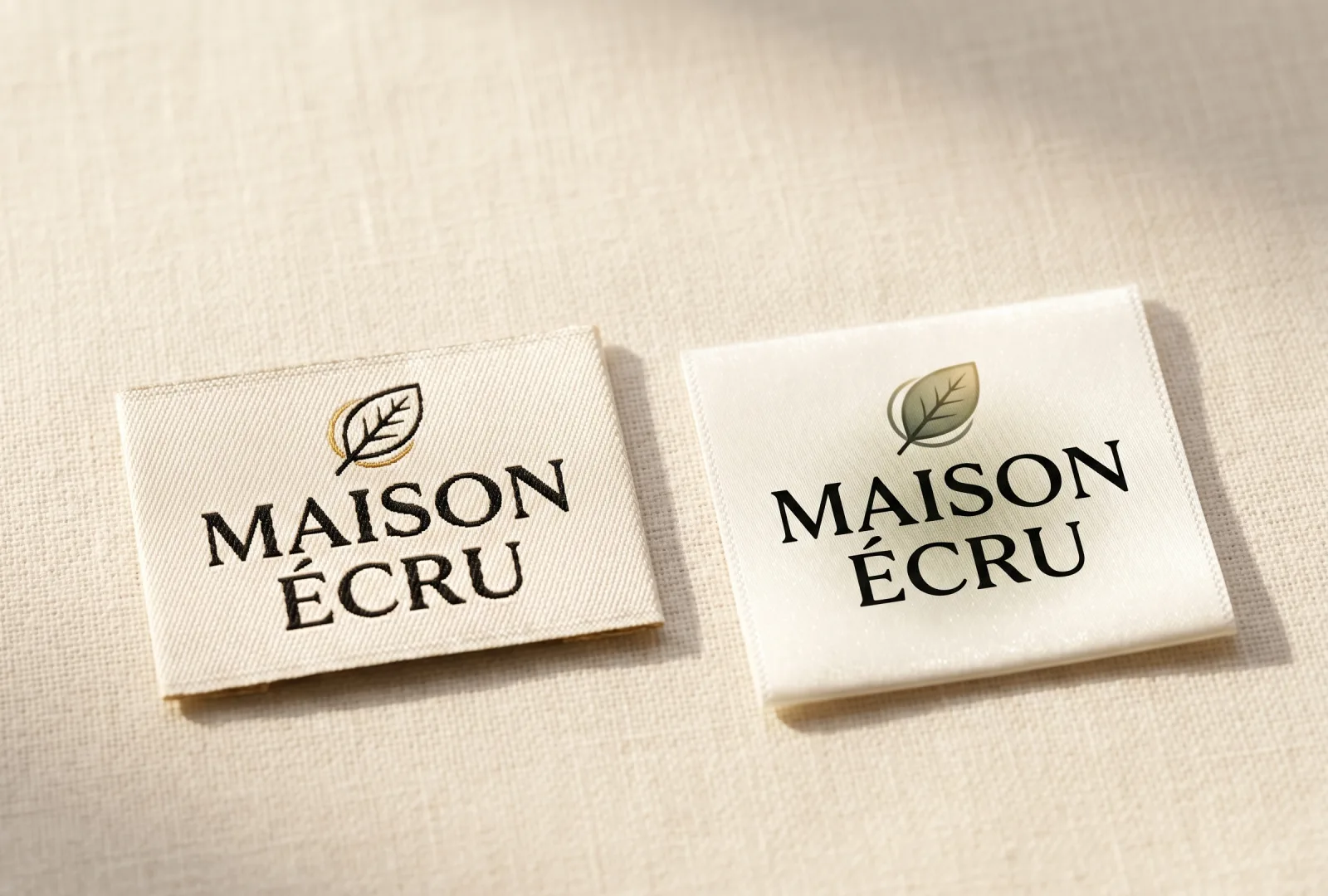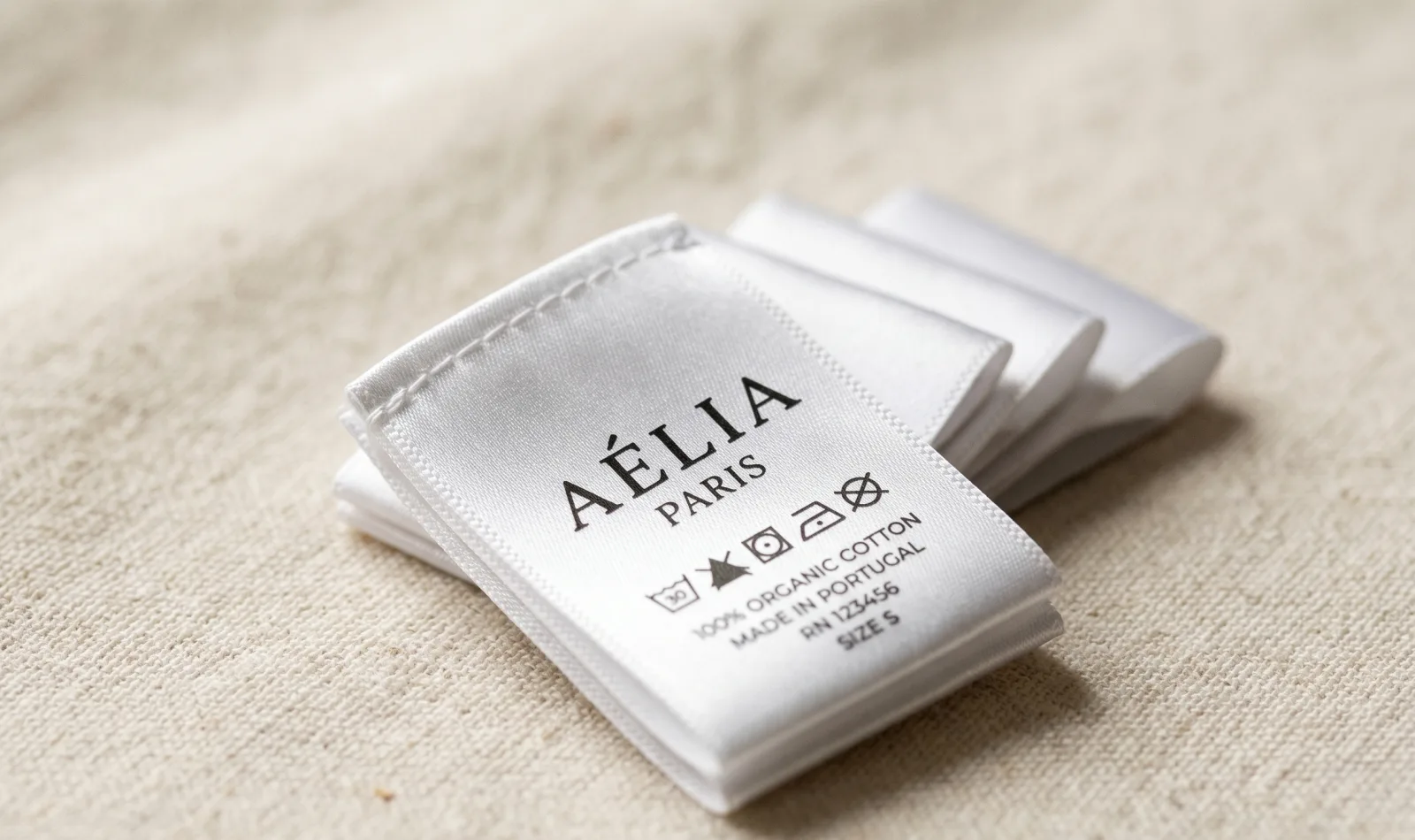
Walk into any garment factory in Ahmedabad, Tirupur or Ludhiana and you'll see two label rolls running through the stitching line more than any other: satin printed and woven. They look superficially similar on the rack — both small fabric strips with brand artwork — but they are made by fundamentally different processes, behave differently in the wash, feel different against skin, and price differently at every MOQ.
This guide breaks down the satin vs woven decision the way a label-buyer actually thinks about it: feel first, finish second, durability third, cost last. By the end you'll know exactly which one belongs on your t-shirt, denim, kidswear, formal shirt or activewear — and where to mix the two on the same garment.
At a glance — satin vs woven
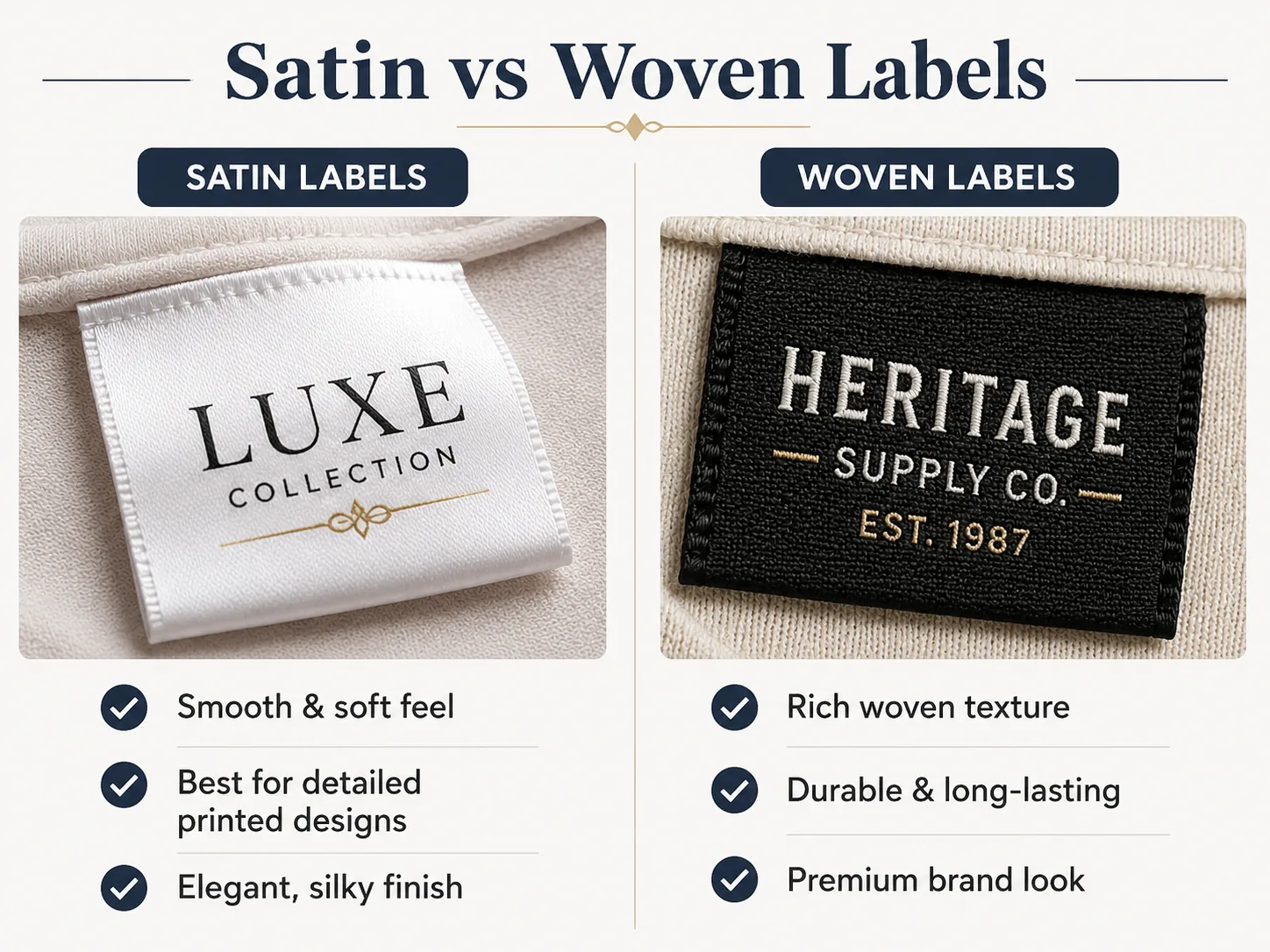
The shorthand: satin printed labels are a soft polyester ribbon with ink sitting on the surface; woven labels are crafted on a jacquard loom where coloured threads form the design through the fabric. Different process, different price curve, different garment fit.
What exactly is a satin label?
A "satin" label isn't satin in the silk sense — in the label industry it refers to a polyester ribbon woven in a satin weave (one face glossy, one face matte). The artwork is then printed onto the glossy face using one of three methods:
- Sublimation print: the most common and highest quality — ink bonds into the polyester fibres. Wash-fast for 50+ cycles.
- Screen print: for solid-block bold artwork at very high volumes; ink sits on top of the fabric.
- Heat-transfer print: cheaper but degrades faster — avoid for premium brands.
Because it's a print process, satin handles any number of colours, gradients, photographic detail and tiny type. That's why fashion brands with illustration-led artwork, kidswear with bright multi-colour wordmarks, and care labels with dense wash-symbol charts almost always run on satin.
What exactly is a woven label?
A woven label is produced on a jacquard loom — the same kind of loom that makes intricate damask fabric. The "design" is created by interlacing coloured warp and weft threads, so the artwork is structural, not surface-printed. You can feel the threads with your fingertip; under a magnifier you can see the weave grid.
- Standard density: ~6,000 stitches per square inch — for general apparel
- High-density: ~10,000+ stitches — for fine type and detail, softer hand
- Damask weave: the most premium — silky finish, intricate detail (see our damask woven labels)
Because the colour is woven into the thread, woven labels never fade — only the substrate wears out. That structural permanence is what makes woven the default for heritage brands, formal wear, denim and outerwear.
Head-to-head: feature by feature
- Full-colour artwork including gradients and photos
- Softer against skin — better for kidswear, innerwear, activewear
- Cheaper at low volumes (under 500 pieces)
- Faster turnaround — 5–7 days vs 10–14 for woven
- Easier prototyping — sample costs lower
- Print can fade if low-quality method is used
- Less "crafted" feel for heritage brands
- Surface ink can chip on rough fabric blends
- Glossy face shows abrasion marks over time
- Permanent colour — never fades, structurally part of the fabric
- Premium, crafted feel — preferred for formal, denim, heritage
- Cheaper at scale (5,000+ pieces narrows the gap fully)
- Better at fine line work with high-density weave
- Damask option for top-shelf luxury feel
- Limited to 1–8 colours — no gradients, no photo detail
- Can feel scratchy at low-density weave
- Tiny text below 1.6 mm height is hard to weave cleanly
- Higher MOQ economics for unique colours
- Longer lead time on first-time designs
Cost ladder — what you'll actually pay
Representative pricing for a 25 × 40 mm centre-fold neck label in Ahmedabad, 2026:
Read it as a curve: satin is ~40% cheaper than woven at low MOQ, ~45% cheaper at mid MOQ, and ~45% cheaper at high MOQ. The gap doesn't close as aggressively as some sources claim — but the absolute rupee difference is small enough at high MOQ that the right call is usually feel-based, not price-based.
By garment type — which is the right pick?
- Kidswear & babywear (skin-soft default)
- Innerwear, loungewear, sleepwear
- Activewear & yoga apparel
- Care labels (any garment) — dense symbol charts
- D2C contemporary fashion with full-colour artwork
- First-time D2C brands prototyping under 500 pieces
- Formal shirts & suits
- Denim & outerwear
- Heritage / boutique / premium brands
- Saree blouse & ethnic-wear brand labels
- School blazer crests & uniform brand labels
- Anywhere "feel of permanence" matters
The hybrid approach — use both
Premium brands rarely pick one and reject the other. The most common production setup we run is:
- Neck brand label: woven (permanent, premium, "this is the brand")
- Care label: satin printed (dense wash symbols, multi-language)
- Size tab: satin printed or pre-made stock (cheap, replaceable)
- Hem flag: woven (visible from outside, brand reinforcement)
This splits the spend where it matters and keeps the soft surfaces (care label tucked at the side seam) soft. For a deeper look at where each label belongs, see hem tags vs neck labels.
Decision matrix — pick in 30 seconds
Go satin. Woven can't reproduce gradients and capping at 8 colours often forces you to redraw the logo.
Go woven. Customers expect the feel of permanence here — printed satin reads as cheaper.
Go satin (or heat-press). Woven scratches; satin glides.
Go satin. Cheaper sample yardage means you can prototype 3 design variants for the price of one woven setup.
Pro tips before you order
Ask for a physical sample, not a digital proof. The single biggest cause of buyer regret is approving artwork on screen, then discovering the printed result looks different. Both satin and woven samples cost ₹250–400 at Labelwala — money well spent before bulk.
Watch out for "satin" that's actually polyester ribbon. Some suppliers cut corners with plain polyester instead of true satin-weave polyester. Real satin has a distinct glossy face and matte reverse — feel both sides before approving the lot.
Quick start: WhatsApp us your artwork and target garment. We'll send a side-by-side mock of how it would look as satin vs woven, with per-piece prices at 100 / 500 / 1,000 pieces — within 4 hours. Message Labelwala or use the quote form.
The short answer
If you're launching a contemporary D2C brand with colour-rich artwork under 500 pieces, start with satin. If you're an established heritage, denim or formalwear brand ordering 1,000+ pieces with simple wordmark artwork, go woven. If you're somewhere in the middle — use both on the same garment. There's no rule that says you must pick a side.