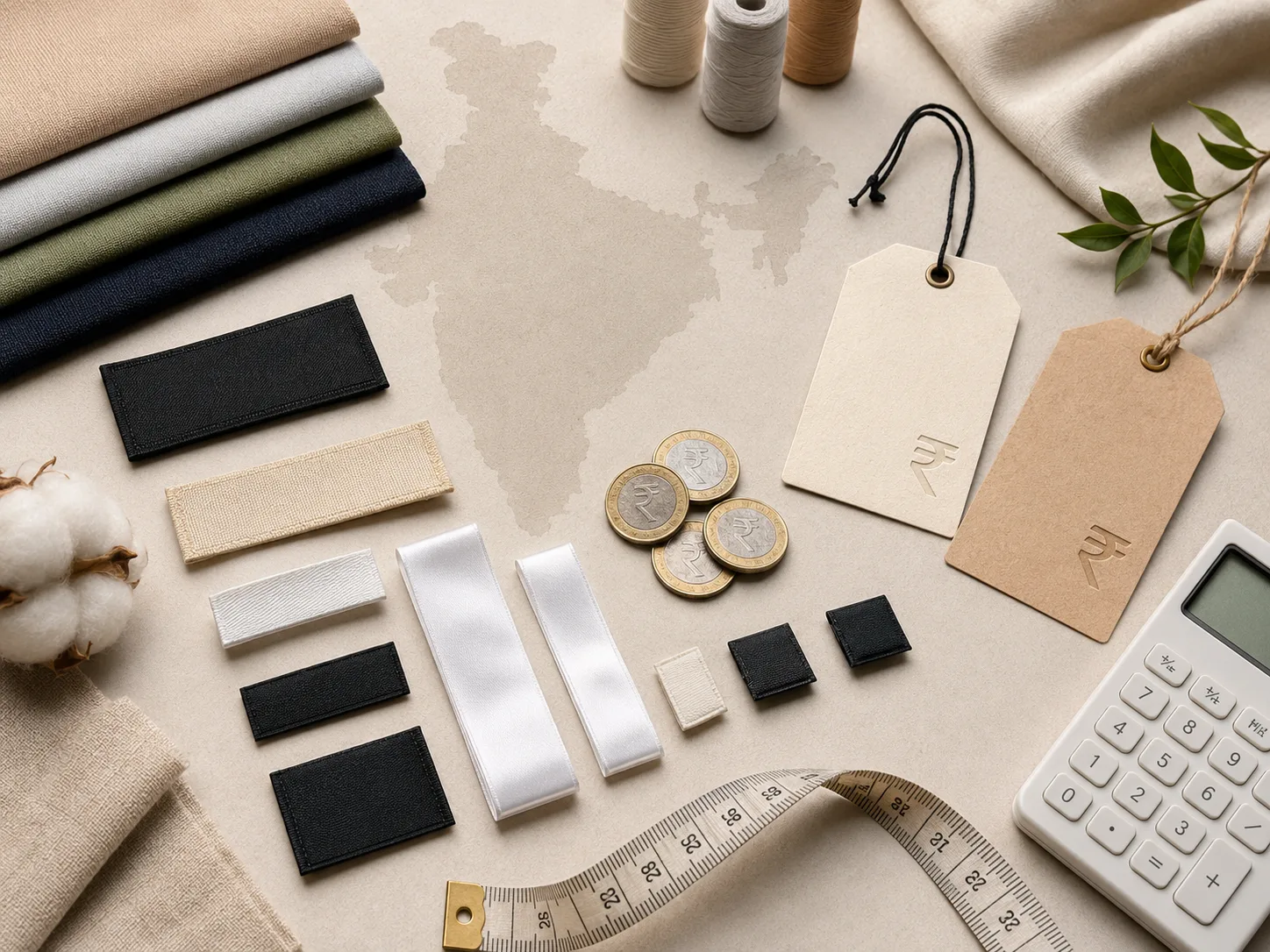
You've sorted your woven neck label and your printed care label — the parts the wearer sees. But there's one branding piece that works before anyone even tries the garment on: the hang tag. It hangs off the outside, it's the first thing a shopper touches on the rail, and it's where your price, size and barcode live. Get it right and it lifts the whole product; get it wrong and even a great garment can look cheap.
This guide walks through what a hang tag is, the materials and shapes to choose from, what to print, how they attach, and how to design one that actually helps you sell — with realistic 2026 pricing for India.
What is a hang tag — and why it matters
A hang tag (also called a swing tag or price tag) is a small printed card attached to a garment by a string, pin or loop. Unlike a sewn-in label, it sits on the outside of the product and is removed by the customer after purchase. It does three jobs at once:
- Sells — it's your brand's handshake on the shelf, carrying logo, story and finish
- Informs — price, size, style code and barcode for the shop and the shopper
- Signals quality — thick stock, a nice string and a clean layout make a ₹800 tee feel like a ₹1,500 one
A sewn-in label and a hang tag are not the same thing and don't replace each other — the label stays with the wearer, the tag is for the shopper. If you sell in stores or care about unboxing, you want both. We cover the split in detail in woven label vs hang tag vs sticker.
Hang tag materials & stock
The single biggest driver of how a tag feels is the card stock. Here are the common choices:
The everyday workhorse. Smooth, takes colour and photos well, cheap at volume. Great all-rounder for most brands.
Natural brown, uncoated. Perfect for organic, handmade, eco and boho brands. Pairs beautifully with jute string.
Uncoated, tactile, premium. Feels expensive in hand — a favourite for boutique and designer labels.
A fabric or leather swing tag reads as premium and durable — common on denim, bags and streetwear.
Rule of thumb: go 300 GSM or heavier. Anything thinner bends and curls on the rail and instantly reads as low-cost. The stock is where "premium" is won or lost.
Shapes & sizes
There's no legal size — but a few formats have become standard because they carry a logo, price and barcode comfortably without overwhelming the garment:
Rectangles are the safe default. Squares and circles feel modern and boutique. Custom die-cut shapes (a bottle, a leaf, your logo silhouette) cost a little more but stand out — worth it for a hero product. Always sample the size in hand against a real garment before printing thousands.
What to print on your hang tag
Keep the front clean and brand-led; put the functional details on the back. A well-planned tag usually carries:
- Logo / brand name — the hero
- A tagline or one-line story
- Optional: hero colour, foil or texture
- Price (printed, sticker, or tear-off tab)
- Size + style / SKU code
- Barcode for POS
- QR code, care tips, social handles
Price on a sticker, not the print. If you print the price into the tag, a price change means a full reprint. Print the tag once as your brand asset and add a price sticker or tear-off each season — far cheaper and more flexible.
How hang tags attach to garments
The attachment is part of the look — and it decides how fast your team can tag a batch of stock. The main options:
Cotton, jute or waxed string through an eyelet. Premium, boutique feel. Slower to attach.
Common on Indian ethnic wear and sarees. Cheap, secure, easy to remove.
Fired with a tagging gun. Fastest for high volume; the standard in busy retail.
A little pin-loop or bead chain. Sturdy and neat for premium and denim.
Boutique and premium brands lean toward string; high-volume sellers lean toward barbs for speed. Think about who's tagging your stock and how many pieces per hour before you commit.
Finishes that make a tag feel premium
Small finishing touches punch well above their cost:
- Foil stamping — gold, silver or rose-gold logo for instant luxury
- Embossing / debossing — a raised or pressed logo you can feel
- Spot UV — glossy accents on a matte tag
- Rounded corners & die-cuts — soft, modern, non-generic
- Metal eyelet — a small ring that finishes the string hole cleanly
Don't stack every finish. One considered finish (say foil on the logo) looks premium. Foil + emboss + spot UV + neon all at once looks busy and cheap. Restraint reads as confidence.
How much do hang tags cost in India?
Indicative 2026 per-piece rates — final price depends on stock, size, finishes, string and quantity:
As with labels, quantity is the biggest lever — per-piece cost drops sharply from 100 to 1,000 pieces. For how tags fit into your total per-garment branding budget, see our 2026 label price guide.
Designing your first hang tag — a quick checklist
- Start from your logo — the tag is a frame for it, not a poster
- Pick a stock and weight — 300 GSM+, matched to your brand mood (kraft = natural, textured = premium)
- Lay out front vs back — brand on front, price/size/barcode on back
- Choose one finish — foil or emboss or spot UV, not all three
- Decide the attachment — string for boutique, barb for volume
- Set the artwork up right — CMYK, 300 DPI, 3 mm bleed, outlined fonts. See our artwork setup guide
- Sample before bulk — always approve stock, colour and size in hand first
The short answer
A hang tag is your brand's first impression on the rail — a printed card carrying your logo, price, size and barcode, attached by string, pin or barb and removed after purchase. Choose a stock of 300 GSM or heavier, keep the front brand-led and the back functional, add one premium finish, and print the price on a sticker so you never reprint for a price change. Budget roughly ₹1–4 for a simple tag and ₹8–15+ for premium in 2026, with quantity the biggest cost lever. Send us your logo and we'll help you spec and sample a tag that fits your brand and price point.