
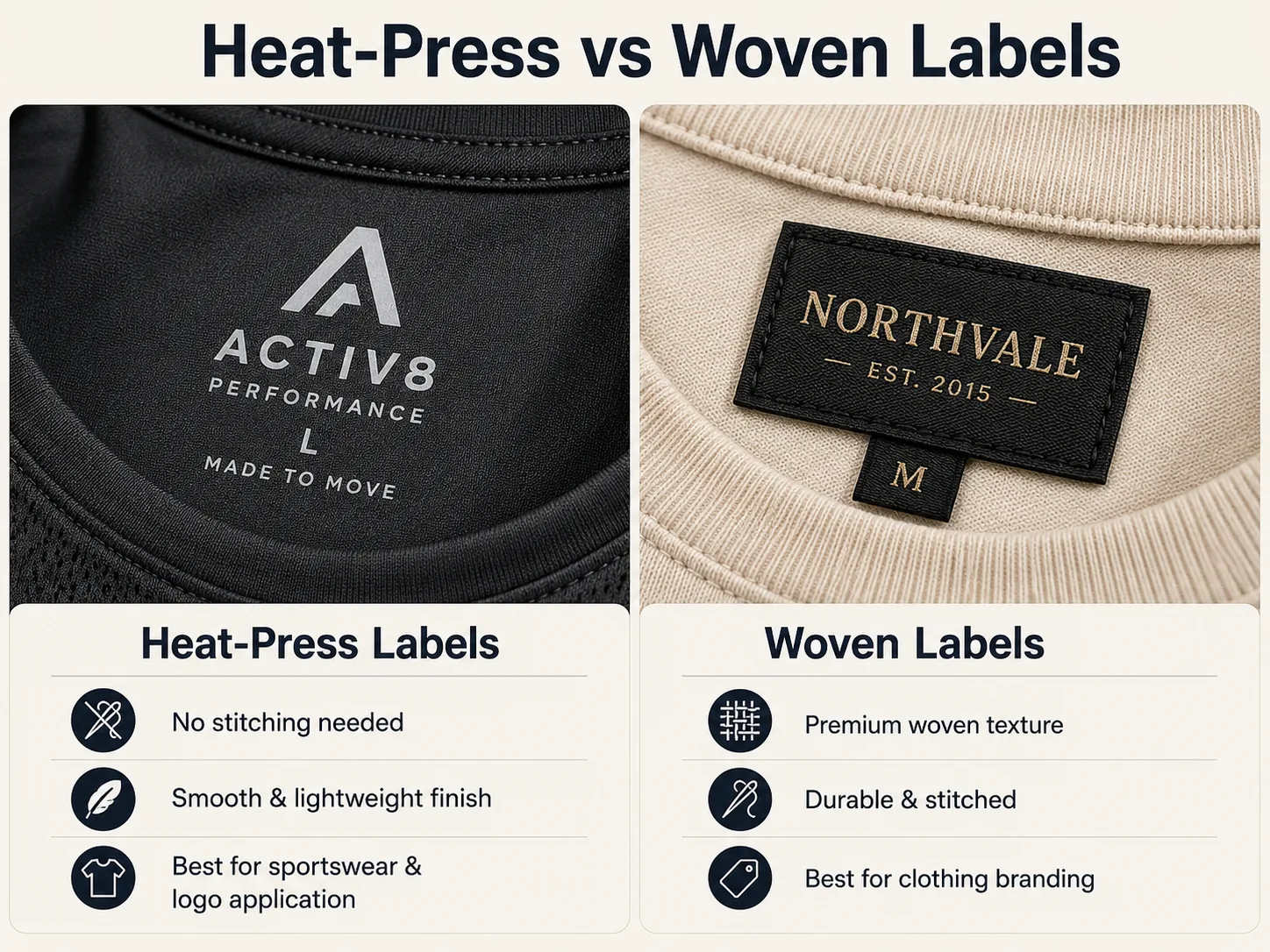
Iron-on or sew-in isn't a quality question — both can be excellent. It's a question of how the label holds on, and what that means once the garment starts getting worn and washed.
One bonds with heat-activated glue and takes seconds. The other is stitched in and never lets go. The right pick depends entirely on your fabric, your laundry and the job the label is doing.
The core trade-off
A heat-seal adhesive on the back bonds to fabric under a hot iron. Fast, needle-free, but the glue is the weak link over heat and time.
Stitched into a seam or onto the fabric with thread. Permanent and fabric-agnostic — the retail standard for brand labels.
How iron-on labels attach
An iron-on label carries a thin layer of heat-activated adhesive on its back. Apply heat and pressure and that glue melts, flows into the surface fibres of the fabric, and sets as it cools — bonding the label in place with no stitching at all.
That's its whole appeal: anyone can do it at home with a household iron, and a full set of name labels goes on in minutes. The catch is that the bond is only ever as strong as the adhesive, and adhesive responds to the same thing that applied it — heat.
How sew-in labels attach
A sew-in label is stitched into the garment — most often folded into a seam so both raw edges are hidden, or stitched flat onto the fabric. Because it's held by thread, not glue, there's nothing to soften, lift or peel.
It's easiest to add during garment construction, when the label is caught in a seam as the piece is sewn. That's exactly why brand neck labels are almost always sewn in at the factory. The fold you choose — end-fold, centre-fold or loop — changes how it sits; our label fold types guide walks through each.
Wash durability: the real dividing line
This is where the two genuinely part ways. A sew-in label survives essentially any wash, because there's no bond to break. An iron-on label applied well to a suitable fabric handles normal home laundry fine — but heat and time work against the glue.
Industrial laundry? Sew it in. Hotel linen, workwear and hostel clothing go through cycles hot and harsh enough to defeat most adhesives over time. See why hotel linen labels disintegrate for what that punishment looks like.
Which fabrics can take an iron-on
Iron-on needs heat to bond — and not every fabric can take that heat. This is the constraint people most often miss.
Cotton, cotton blends and most everyday woven fabrics — they tolerate the iron's heat and let the adhesive grip.
Nylon and heat-sensitive synthetics (can scorch), plus waterproof, coated or highly water-repellent fabrics (won't bond). Also anything delicate.
Test on a hidden spot first. If you're not sure your fabric can handle the iron, press a corner where it won't show. A scorch mark on a test corner is a cheap lesson; one on the garment isn't.
Speed, labour and cost
Beyond durability, the practical difference is time and hands.
- Iron-on is quick and needs no machine or skill — ideal for parents labelling uniforms or a founder doing a small batch by hand.
- Sew-in adds a stitching step. It's effortless when the label is caught in a seam during production, but fiddly to add by hand to a finished garment.
Making garments from scratch? The sewing "cost" of a sew-in label all but disappears, because it goes in as the seam is stitched anyway. Iron-on's speed advantage matters most when you're applying to garments that are already made.
When to choose each
- You're naming uniforms, kit or camp clothing at home
- The fabric is cotton or a cotton blend
- Items are washed normally at home
- You want speed with no sewing machine
- It's a small batch you're applying by hand
- It's a brand label in a garment you're producing
- The fabric is heat-sensitive, coated or delicate
- Items face industrial or heavy laundry
- You want a permanent, retail-grade finish
- The label is caught in a seam during construction
How to apply an iron-on that stays on
Set the iron to the fabric's heat with steam off — moisture stops the adhesive setting.
Hold firm pressure straight down for the full time given, usually 10–15 seconds.
A thin cloth or the supplied sheet spreads heat evenly and protects the label.
The bond finishes as it cools. Touching or wearing it warm is the top reason edges lift.
The short answer
Iron-on and sew-in are both good — they just hold on differently. Iron-on bonds with heat-activated glue: fast, needle-free, perfect for naming cotton clothing washed at home, but limited by heat-sensitive fabrics and heavy laundry. Sew-in is stitched in: permanent, works on any fabric, survives any wash, and is the retail standard for brand labels built into a garment. If you're branding a product line, sew in. If you're labelling finished garments quickly and they're cotton washed at home, iron on — and apply it properly so it never peels. Want a woven or printed label with an iron-on backing? Tell us when you order and we'll build it that way, then sample it before bulk.