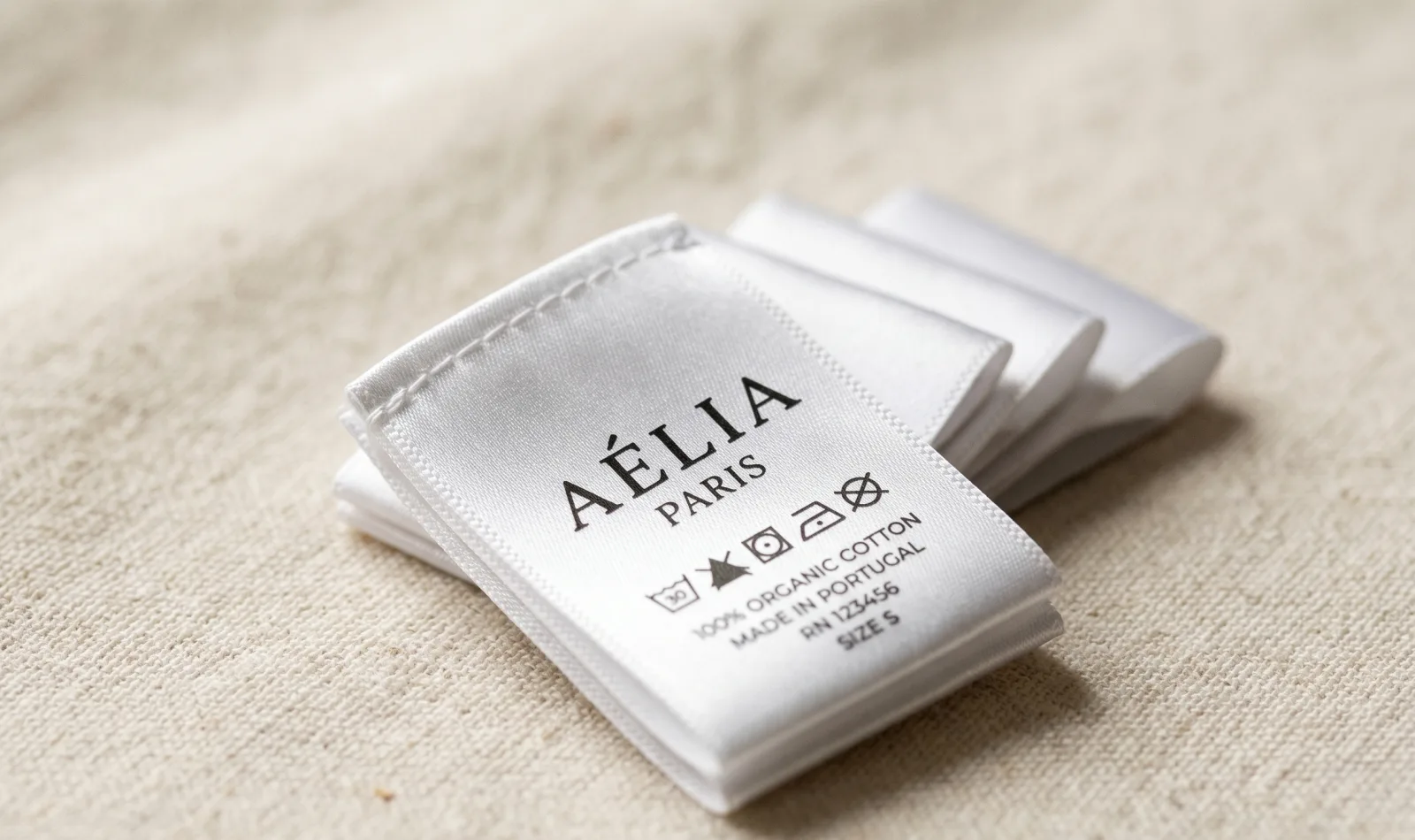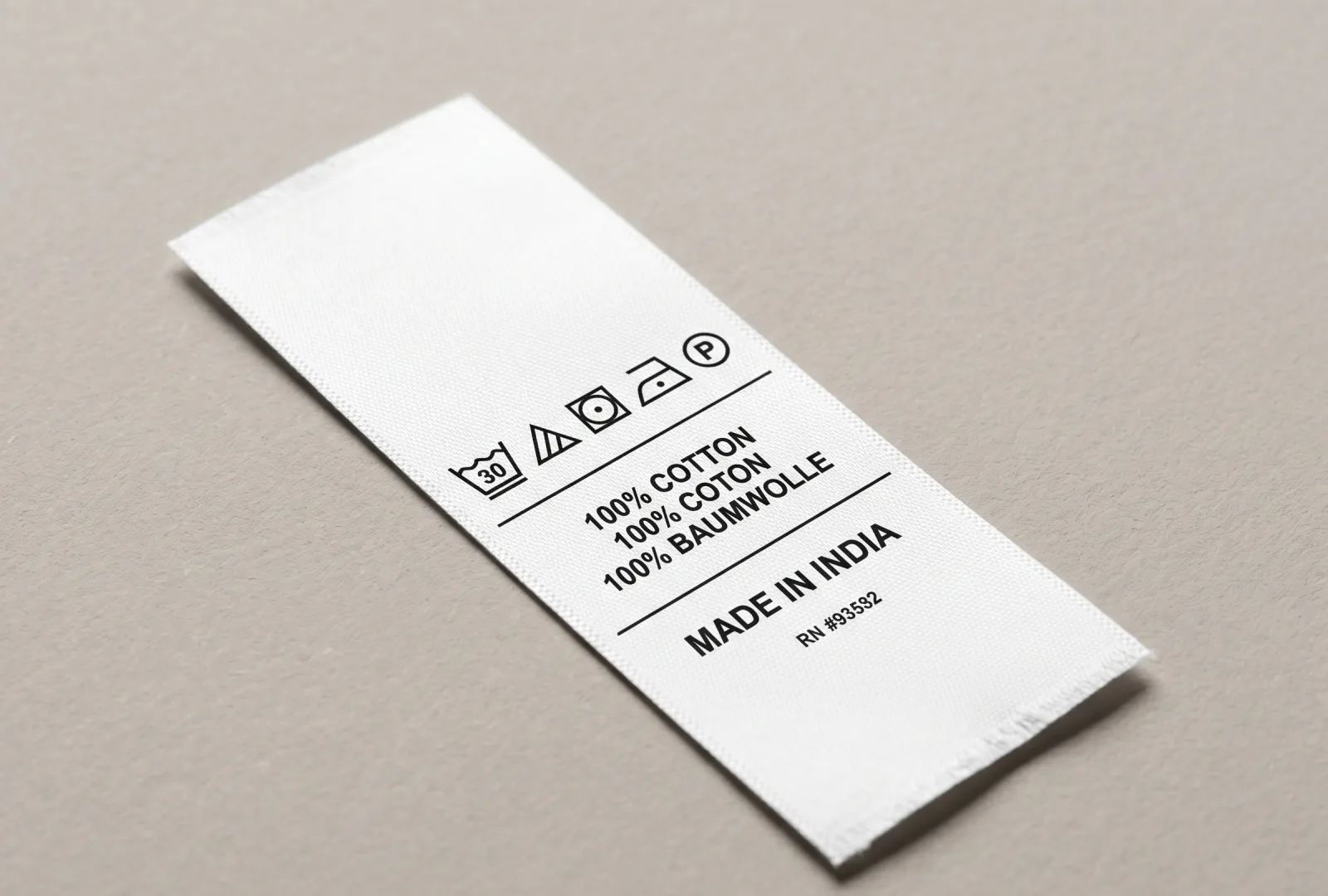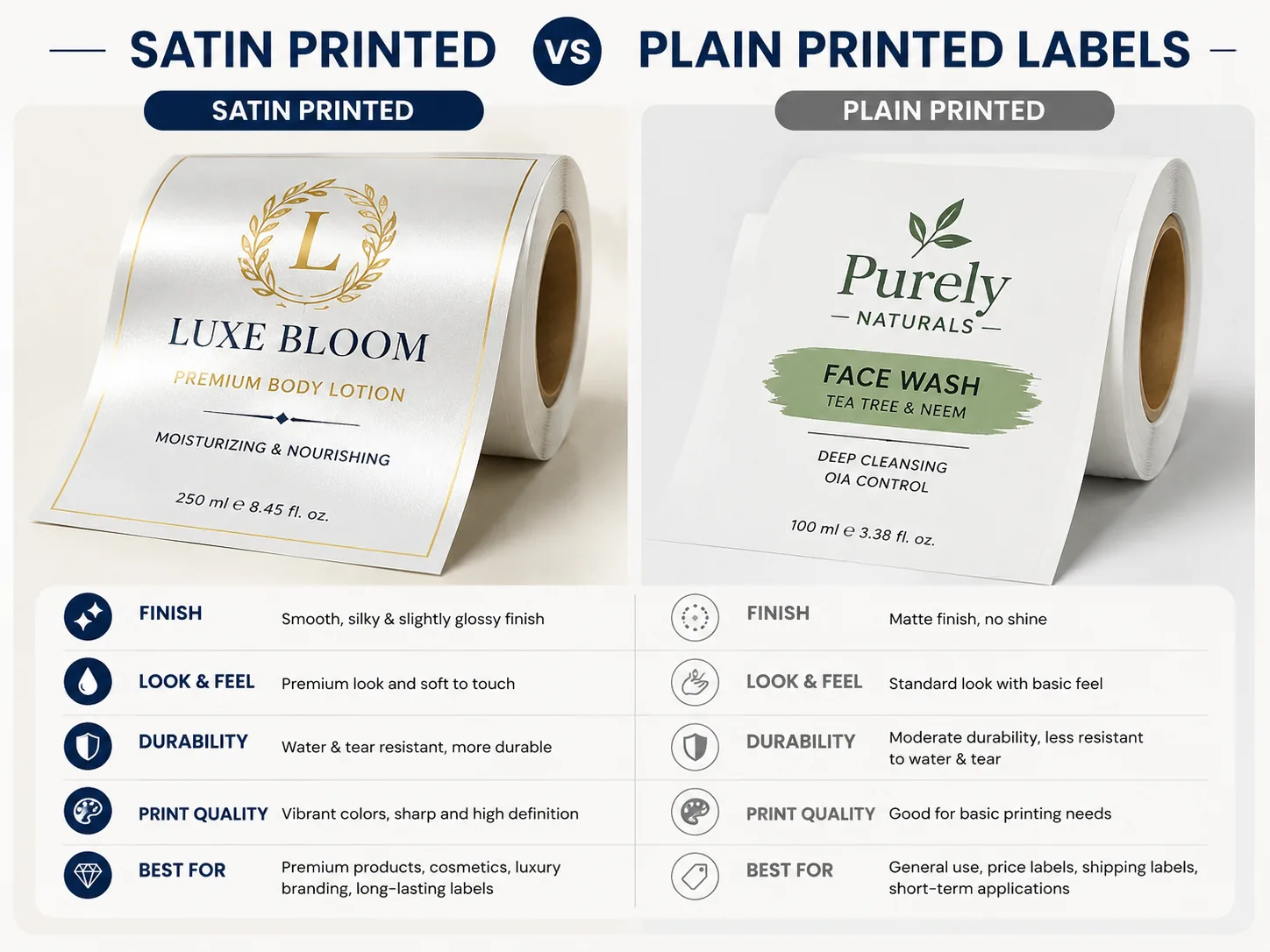
When a label buyer says "printed label," they could mean any of three very different products: a satin printed label (glossy ribbon, soft hand), a taffeta printed label (matte ribbon, sharp print), or a heat-press transfer (ink applied directly to the garment, no fabric label at all). All three fall under "printed" — and they don't behave the same.
This guide breaks down the three printed options that compete for the same buyer, so you can match the right print method to your garment, your artwork and your scale. By the end you'll know when satin wins, when taffeta is the only sensible choice, and when heat-press makes both fabric labels irrelevant.
At a glance — the three printed options
The decision hinges on three questions: how does it touch the skin, how dense is the artwork, and what's the volume. Get those three right and the print method picks itself.
Option 1 — Satin printed labels
The most common printed label in Indian fashion. Soft satin-weave polyester ribbon with the artwork sublimation-printed onto the glossy face. Smooth against skin, mid-range cost, looks premium.
- Substrate: 100% polyester satin ribbon, 25–35 gsm
- Print process: dye sublimation (best), screen print (high volume), or heat-transfer (avoid)
- Colour range: full CMYK + gradients + photographic detail
- Feel: smooth, glossy face; slightly stiff matte reverse
- Best for: kidswear, D2C casualwear, neck labels, care labels with brand artwork
- Cost: ₹0.80–2 per piece at 1,000+ pieces
For a deeper dive into satin specifically, see our satin printed labels buyer's guide.
Option 2 — Taffeta (plain) printed labels
The export-industry workhorse. Tighter-weave polyester or nylon taffeta with sharp printed detail. Matte finish, slightly firmer hand than satin, but vastly clearer text and symbols at small sizes.
- Substrate: nylon or polyester taffeta, 30–50 gsm
- Print process: dye sublimation, ISO 3758 compliant
- Colour range: full CMYK; gradients possible but less smooth than satin
- Feel: matte, slightly papery; stiffer than satin
- Best for: export care labels, uniforms, multilingual wash labels, garments where print sharpness matters more than skin feel
- Cost: ₹0.40–1 per piece at 1,000+ pieces (cheapest of the three)
For the export-buyer perspective, see taffeta labels for garment exporters.
Option 3 — Tagless heat-press labels
The third printed option isn't a label at all — it's ink fused onto the inside of the garment via heat-transfer plates. Used heavily in activewear, yoga apparel, innerwear and any garment where seams shouldn't touch skin.
- Substrate: none — printed directly onto the garment fabric
- Print process: heat-press transfer, silicone 3D dome, or plastisol screen
- Colour range: CMYK; can include raised silicone for premium tactile feel
- Feel: nothing to scratch — softer than any fabric label
- Best for: activewear, yoga, innerwear, athleisure, kidswear premium tier
- Cost: ₹0.30–0.80 at 5,000+ pieces; ₹2–4 at 100 pieces (setup-heavy)
For the activewear context, see tagless heat-press labels for activewear.
Head-to-head — feature comparison
- Softest fabric label against skin
- Best for full-colour brand artwork
- Premium glossy finish
- Mid-tier price across all MOQs
- 5–7 day turnaround
- Sharpest print for tiny text & symbols
- ISO 3758 export-grade standard
- Survives industrial laundry
- Lowest cost at scale
- 5–7 day turnaround
- Zero fabric — nothing to scratch
- Built into the garment, can't fall off
- Premium activewear standard
- Cheapest at 5,000+ pieces
- 10–14 day turnaround (plates needed)
Cost ladder across the three
Representative pricing for a 25 × 40 mm neck label / equivalent heat-press footprint, 2026:
Read the curve: taffeta is cheapest at every volume. Satin sits in the middle for premium feel. Heat-press is the most expensive at small MOQ (plate setup ~₹2,500) but converges with taffeta at 10,000+ pieces.
By garment type — which to pick
- Kidswear neck & brand labels
- D2C casualwear brand label
- Boutique fashion (ethnic, occasion wear)
- Premium care label with brand graphic
- Export care labels (multilingual)
- Uniform care & size labels
- Hospital, hotel, restaurant linen
- Long ISO 3758 wash-symbol charts
- Activewear, yoga, athleisure
- Innerwear, underwear, sleepwear
- Premium kidswear (2-year+ life expectancy)
- Performance fabrics with stretch
- Satin → if you need ISO export sharpness
- Taffeta → if it's a luxury neck label (feels papery)
- Heat-press → if you'll change artwork in < 6 months
The hybrid setup most brands actually use
The smartest production setups don't pick one — they assign each option to the job it does best:
- Neck brand label: satin printed (premium feel, brand-visible)
- Side-seam care label: taffeta printed (sharp symbols, ISO-compliant, tucked out of sight)
- Size tab: taffeta printed (cheapest) or pre-made stock
- Inside neck reinforcement (activewear): heat-press tagless
This split lets each material do what it's best at — and keeps the per-garment label spend roughly the same as picking any single option in isolation.
Decision matrix — 30-second pick
Yes → heat-press tagless (best) or satin (next best). Avoid taffeta on inner garments.
Taffeta. Its tighter weave keeps small text legible at high information density.
Satin. Its glossy face gives gradients and photographic detail a premium presentation.
Heat-press becomes cost-competitive and gives the cleanest finish. Otherwise stick with fabric labels.
Pro tips before you order
Order all three samples together. Satin, taffeta and a heat-press swatch all cost ₹250–400 each to sample. Compare them side-by-side under your artwork before committing to bulk.
Watch the print process, not just the substrate. A heat-transfer print on satin will fade in 10 cycles; a sublimation print on the same satin lasts 50+. Always specify sublimation when ordering printed labels.
Quick start: send us the artwork and the garment type. We'll send a side-by-side mock-up of satin vs taffeta vs heat-press with per-piece prices at 100 / 500 / 1,000 pieces. Message Labelwala or use the quote form.
The short answer
If you want a premium-feel brand label that handles colour-rich artwork, go satin. If you need an export-compliant care label with sharp small text and multiple languages, go taffeta. If you're making activewear or innerwear where labels shouldn't touch skin at all, go heat-press tagless. Most well-built production lines use all three in different positions on the same garment.