
There's a specific moment every yoga-wear customer has had: tag itching mid-pose, hand reaching back to scratch, fingers find a stiff woven label, mental note to cut it out the moment they get home. For activewear brands, that one moment is a return waiting to happen — and it's why tagless heat-press labels exist.
What "tagless" actually means
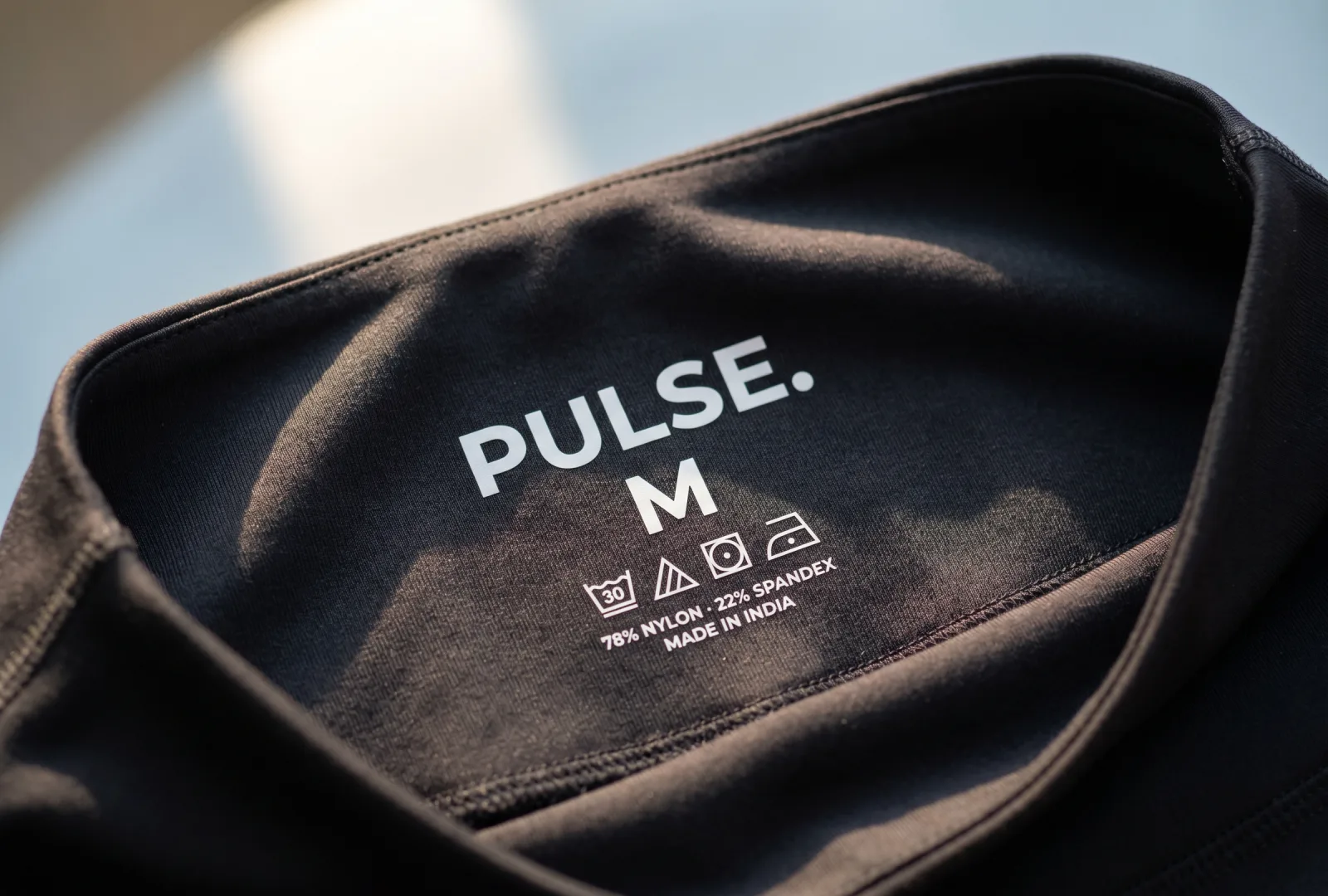
A tagless label isn't a label at all in the traditional sense — it's printed directly onto the inside of the garment, usually with heat-transfer or sublimation. There's no fabric tag, no edge to chafe, no thread to scratch. The brand mark, size and care symbols all live on the fabric itself.
Two main techniques produce tagless labels:
- Heat-transfer (HTV) — vinyl applied with heat and pressure. Works on cotton and most blends.
- Sublimation — dye fused into polyester fibres at high temperature. Works only on polyester or majority-polyester fabrics.
Why activewear specifically needs them
Three reasons stretch and sweat make traditional labels a problem:
- Stretch. A woven label stitched into stretch fabric creates a stiff zone. The fabric stretches; the label doesn't. Customer feels it during every move.
- Skin contact. Sports bras and leggings hold tight to skin. Tag chafing is amplified when fabric isn't loose.
- Sweat. Damp fabric makes traditional tags stiffer and more itch-prone.
Tagless solves all three because there's no physical tag to feel.
Where tagless works (and where it doesn't)
- Yoga leggings, tights, joggers (high-stretch)
- Sports bras, crop tops, racer-backs (skin-contact)
- Gym tees, training shirts, performance polos
- Any stretch + skin-contact + sweat environment
- Outerwear, jackets — premium woven adds value
- Heritage / boutique — label is part of the brand
- Garments washed above 60°C — adhesive softens
- Anywhere woven satin would feel right
Durability vs woven
Sublimation on polyester is the most durable — dye fuses into the fibre and lasts as long as the garment itself. Most activewear brands run tagless inside (leggings, sports bras) + woven outside (jackets, gym bags). Best of both.
What goes on a tagless label
Same content as a traditional label set, but consolidated into one print:
- Brand logo / wordmark.
- Size (XS / S / M / L / XL).
- Fibre composition (e.g. "78% Nylon, 22% Spandex").
- Wash care symbols (3–5 ISO icons).
- Country of origin ("Made in India").
Layout typically runs in two columns or a stacked block, sized roughly 30×60mm or 40×80mm. Logo on top, size in big bold below, then care symbols, then composition and origin in smaller text.
Cost reality
Indicative per-piece pricing for tagless heat-press on cotton or poly-cotton:
Sublimation on polyester is similar at low volumes, slightly cheaper at high volumes. Tagless costs 20–30% more than equivalent printed labels at low volumes; gap closes at scale.
Quality red flags
- Edges peeling on sample. Indicates wrong heat or pressure curve. Walk away.
- Print feels stiff/plasticky. Cheap thick HTV. Modern thin-vinyl HTV is barely perceptible.
- Visible white box around the print. Indicates the supplier is using full-square HTV instead of cut-to-shape. Looks unprofessional.
The hybrid play: many activewear brands use tagless heat-press inside (skin contact) + woven hem tag outside (visible branding). Best of both — soft inside, premium signal outside.
For sustainable / eco brands
Heat-transfer vinyl is plastic-based — which can clash with organic / eco brand positioning. Three eco-friendly alternatives:
- Water-based screen prints — directly on cotton, biodegradable inks.
- Sublimation on recycled poly — dye-fused, fits "recycled performance" positioning.
- Soft cotton-tape labels — not tagless, but extremely soft. Works for less stretch-heavy yoga garments.
If your brand is GOTS-certified or sustainability-positioned, default to water-based screen on cotton or sublimation on recycled poly.