
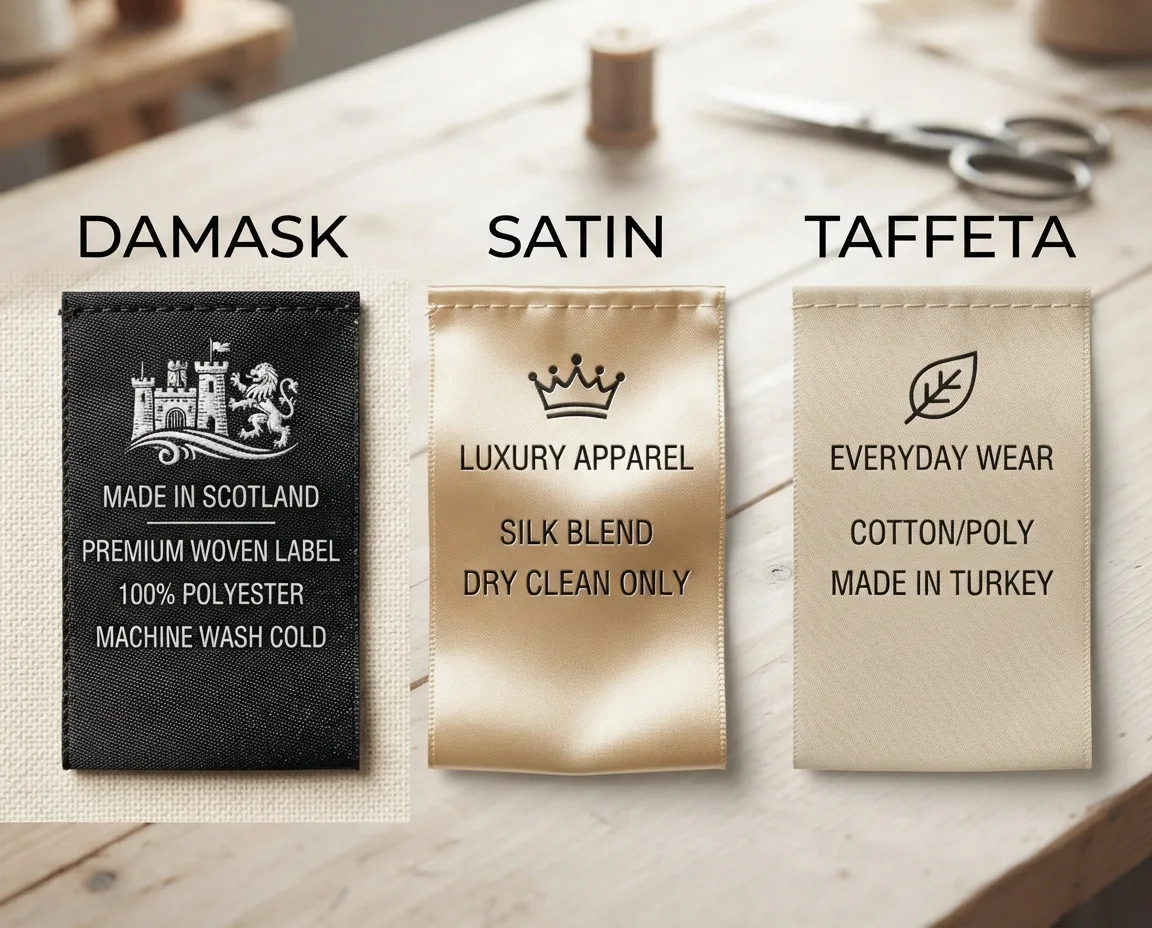
Ask for a "woven label" and you'll be offered a choice you might not expect: damask, satin or taffeta. They're all woven, all usually polyester, all made on the same kind of jacquard loom. What separates them is how fine the thread is and how the weave is built — and that changes the feel, the detail and the price.
Here's each one in plain terms, so you can match the material to the job instead of guessing.
The three base weaves at a glance
If you remember nothing else, remember this hierarchy: taffeta is the workhorse, satin is the smooth one, damask is the premium one.
Damask — the premium weave
Damask is woven from the finest yarn at the highest thread density. That fineness is exactly why it holds the smallest text and the sharpest logo detail, with a smooth, dense, soft-to-the-touch surface. It's the material fashion brands reach for when the neck label is part of the product experience.
The trade-off is cost: finer yarn and a tighter weave take more time and material, so damask sits at the top of the woven price range. If your logo is detailed or your brand is premium, it earns it. For a deeper look, see woven vs damask.
Fashion main labels, detailed logos, small text, premium neck labels where feel matters.
Highest of the three — the finer, denser weave costs more to produce.
Satin — the smooth, subtle-sheen weave
Satin weave gives a smooth surface with a soft, gentle sheen — a more refined look than a flat matte label. Woven satin labels feel soft against skin, which is why satin is popular for neck and main labels where you want a hint of luxury without full damask cost. Satin is also the go-to base for printed labels, because its smooth face takes print cleanly — see satin printed labels.
Satin can be woven or printed. Woven satin means the design is in the weave; printed satin means ink on a satin base. If you want the sheen and the durability of woven, ask specifically for a woven satin label.
Taffeta — the economical workhorse
Taffeta is a crisper, slightly firmer weave. It's the most economical of the three and extremely durable, which makes it the classic choice for internal labels — especially care and wash labels sewn into a side seam, where cost and durability matter far more than a luxury hand-feel. It's slightly the coarsest of the three, so it isn't the first pick for a label pressed against sensitive skin all day.
Care labels, size labels, high-volume internal labels, garment-export runs where cost leads.
Lowest of the three — the value option for internal labelling at scale.
Which one should you choose?
Match the material to the label's job, not to a spec sheet.
- It's a visible main or neck label
- Hand-feel is part of the brand experience
- Your logo is detailed or has small text
- You want a subtle sheen (satin) or top sharpness (damask)
- It's an internal care or size label
- Cost and durability lead the decision
- You're producing at high volume
- The label won't sit against sensitive skin
The smartest brands mix materials: a damask or satin main label people see and feel, a taffeta care label doing the quiet work inside the seam.
The short answer
Woven labels come in three common materials, all usually polyester. Damask is the finest and softest, with the sharpest detail and the highest cost — best for premium main labels. Satin weave is smooth with a subtle sheen, a refined middle ground. Taffeta is crisp, durable and economical — the workhorse for care and internal labels. Pick by the label's job: feel and detail push you toward damask or satin, cost and volume push you toward taffeta. Unsure? Ask us for a sample of each against your actual garment fabric — feeling them side by side settles it in seconds.