If there's one question every first-time founder, school admin and uniform vendor asks before placing an order, it's this: "What size should the label be?" There's no single right answer — different label types follow different rules, and the right dimension depends on the garment, the placement, the artwork and the budget.
This guide collects every standard label size we produce, in one place — neck and brand labels, care labels, size tabs, hem tags, woven and printed patches, ribbons, name & number tapes, school crests and heat-press transfers. All dimensions are in millimetres, the unit our looms and cutting machines work in, and every recommendation is calibrated for Indian garment manufacturing tolerances.
Why label size is not a one-line answer
Label size is the single design decision that quietly drives three things at once: how the label reads, how it feels against skin, and how much it costs per piece. A label that is 5 mm too wide may scratch the wearer's neck on every wash; one that is 3 mm too narrow may cut off the descender of a "g" in your wordmark. And because price scales with area, a 30 × 50 mm label is roughly 50% more expensive than a 25 × 40 mm one — for exactly the same artwork.
The right size is the smallest rectangle that:
- Holds your artwork at the legibility threshold of the chosen process (woven looms cap detail at ~0.4 mm stroke width; printing at ~0.2 mm).
- Sits within the garment's available stitching window (necklines, waistbands and inseams each have their own clearance budget).
- Folds cleanly for the fold style you've chosen (centre-fold doubles the cut length; book-fold quadruples it).
Quick reference: when in doubt, send us a flat artwork at any size and we'll return three production-ready dimensions (compact, standard, premium) with prices for each. Message Labelwala.
The master size chart — every label type at a glance
Use this as a cheat-sheet. Each row is a label type with the typical width × height range we produce, plus the most-ordered "sweet-spot" dimension that fits 80% of brands.
Below, each type gets its own deep-dive — what drives the size, what the most common mistakes are, and what we recommend for the most popular use cases.
1. Neck & main brand labels
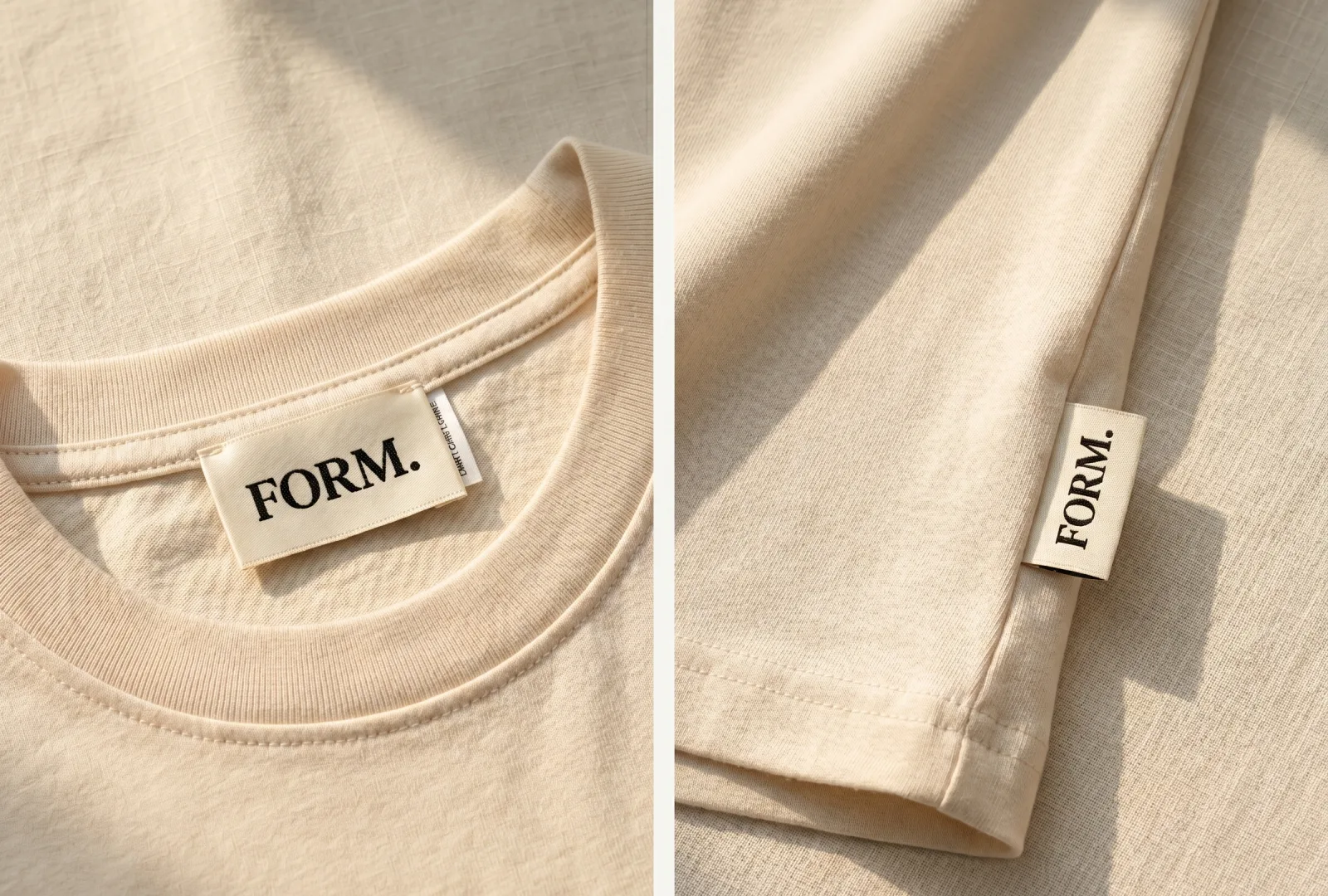
The neck label is the brand's signature on the inside of the garment. Its size is governed by two constraints: the width of the neckline stitching window, and the height required to fit a wordmark plus a tagline or country-of-origin line.
- Standard: 25 × 40 mm (centre-fold → 25 × 20 mm visible)
- Compact: 20 × 35 mm for premium minimal brands
- Use end-fold for a clean two-sided finish
- Material: woven cotton or satin printed
- Standard: 30 × 50 mm (allows wordmark + size + country)
- Damask weave preferred for heritage feel
- Stitched flat on the collar band, not folded
- Material: damask woven or premium satin
- Standard: 35 × 60 mm — needs to balance heavy fabric
- Often paired with a leather/PU patch at the waistband (50 × 70 mm)
- Loop-fold or end-fold; never centre-fold (too thick)
- Material: damask woven, heavy taffeta or leatherette
- Standard: 20 × 35 mm (or tagless heat-press 30 × 40 mm)
- Soft satin only — no scratchy woven on babywear
- Pre-shrunk material to avoid puckering
- Material: ultra-soft satin or silicone heat-transfer
Common mistake: brands order the same 30 × 50 mm label across their full range. It looks oversized on a women's tank top and undersized on a heavy jacket. Pick per garment category, not per brand.
2. Care & wash labels
Care labels are the long, thin labels with wash symbols, fabric content and country of origin. Their width is fairly fixed (25–30 mm) because the ISO 3758 wash symbols need a minimum legibility size. Their length is what varies — driven by how much regulatory text needs to fit.
Anything past 100 mm should be book-folded (folded in half along its length) so it doesn't dangle outside the side seam. Book-fold doubles the printable area without doubling the visible footprint, which is exactly what export labels need.
- Width: 25 mm fits 4 wash symbols in a row at minimum legibility; 30 mm allows 5 symbols + spacing.
- Wash symbols: 8–10 mm tall on a 25 mm wide label; 10–12 mm on a 30 mm label.
- Fibre content text: minimum 1.6 mm character height (~8pt) for ISO compliance.
- Material: taffeta is standard for export (sharper symbols, ISO-compliant); satin for domestic (softer feel).
For an in-depth breakdown of which symbols belong on which fabric, see our care label symbols & fabric guide.
3. Size tabs (XS, S, M, L, XL…)
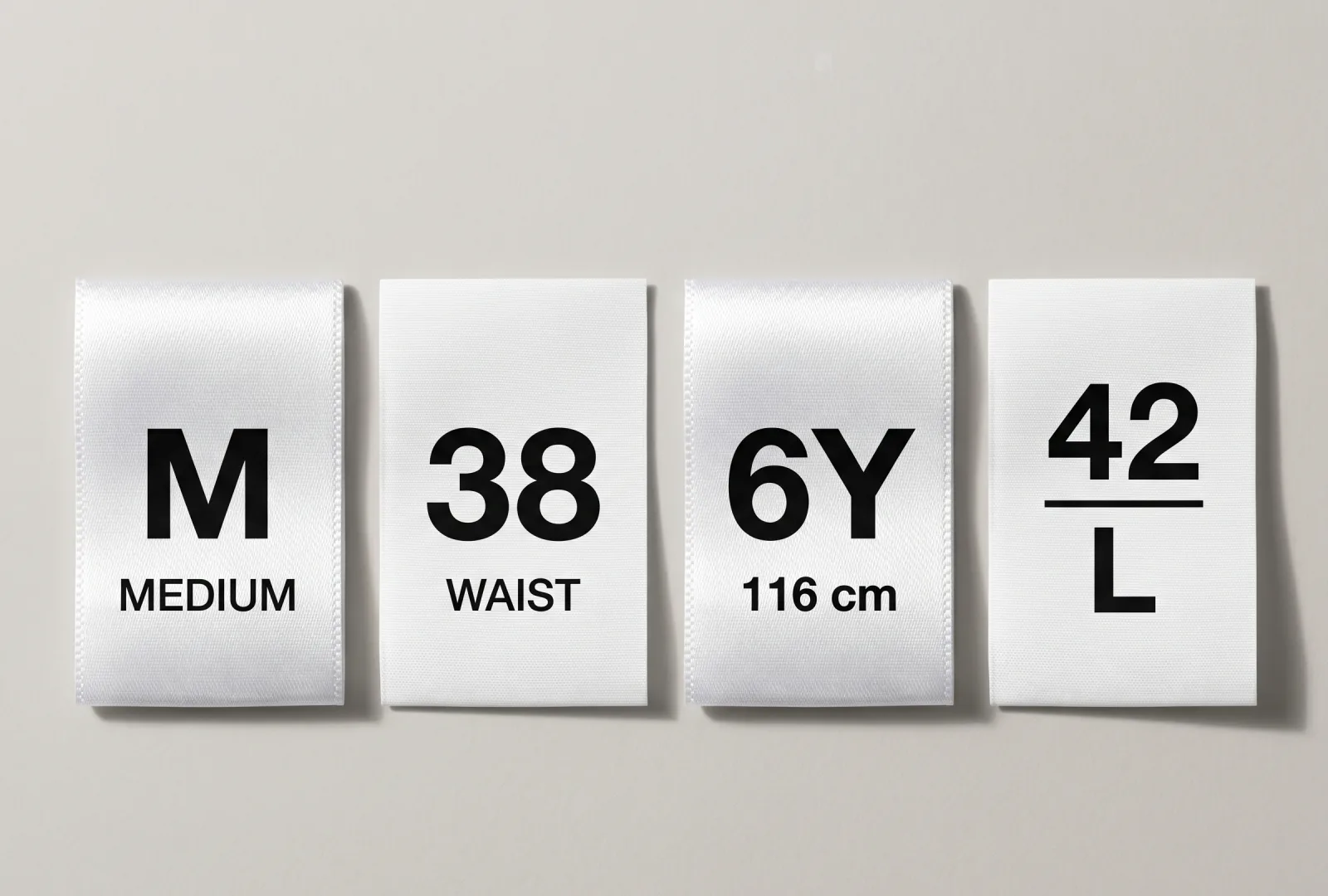
A size tab is the smallest label on the garment, often a single character. Most brands prefer a standalone tab on basics and combine the size into the main neck label on premium pieces.
- 15 × 20 mm for adult alphabetic (XS–3XL)
- 20 × 25 mm for numeric (28, 30, 32…) — fits two digits
- 20 × 30 mm for kidswear with age + height (e.g. "6Y / 116 cm")
- Loop-fold or end-fold
- 25 × 30 mm for IN / EU / UK on one label ("L / 42 / 16")
- 30 × 35 mm for retail-export with 3 systems + barcode panel
- Always book-folded for export
- Pre-made stock available from 15 × 20 mm — see stock size labels
Anything below 12 × 18 mm becomes hard to grip during stitching and slows production. Anything above 30 × 40 mm starts to compete visually with the brand label — defeating the purpose.
4. Hem tags & side-seam labels
Hem tags are the small folded flags that hang from the side seam or hem edge — visible from the outside of the garment. Their size and position are more visible than any other label, so the proportions matter more.
- Mini hem flag: 15 × 30 mm (folded) — discreet, sits at hem corner
- Standard hem tag: 25 × 50 mm (folded → 25 × 25 mm visible) — most common
- Statement hem tag: 30 × 70 mm — for streetwear and graphic-led brands
- Side-seam tab (waist): 20 × 60 mm — placed 4–6 cm above hem on tees and tanks
- Inseam label (denim): 35 × 90 mm — leather or leatherette, riveted or stitched
The folded length should always be roughly 2× the visible length so the fold sits flat against the seam. Order in continuous reel form if you produce in volume — the factory can cut and stitch in a single pass.
For a full breakdown of where hem tags belong vs neck labels, see our hem tags vs neck labels guide.
5. Woven & printed patches
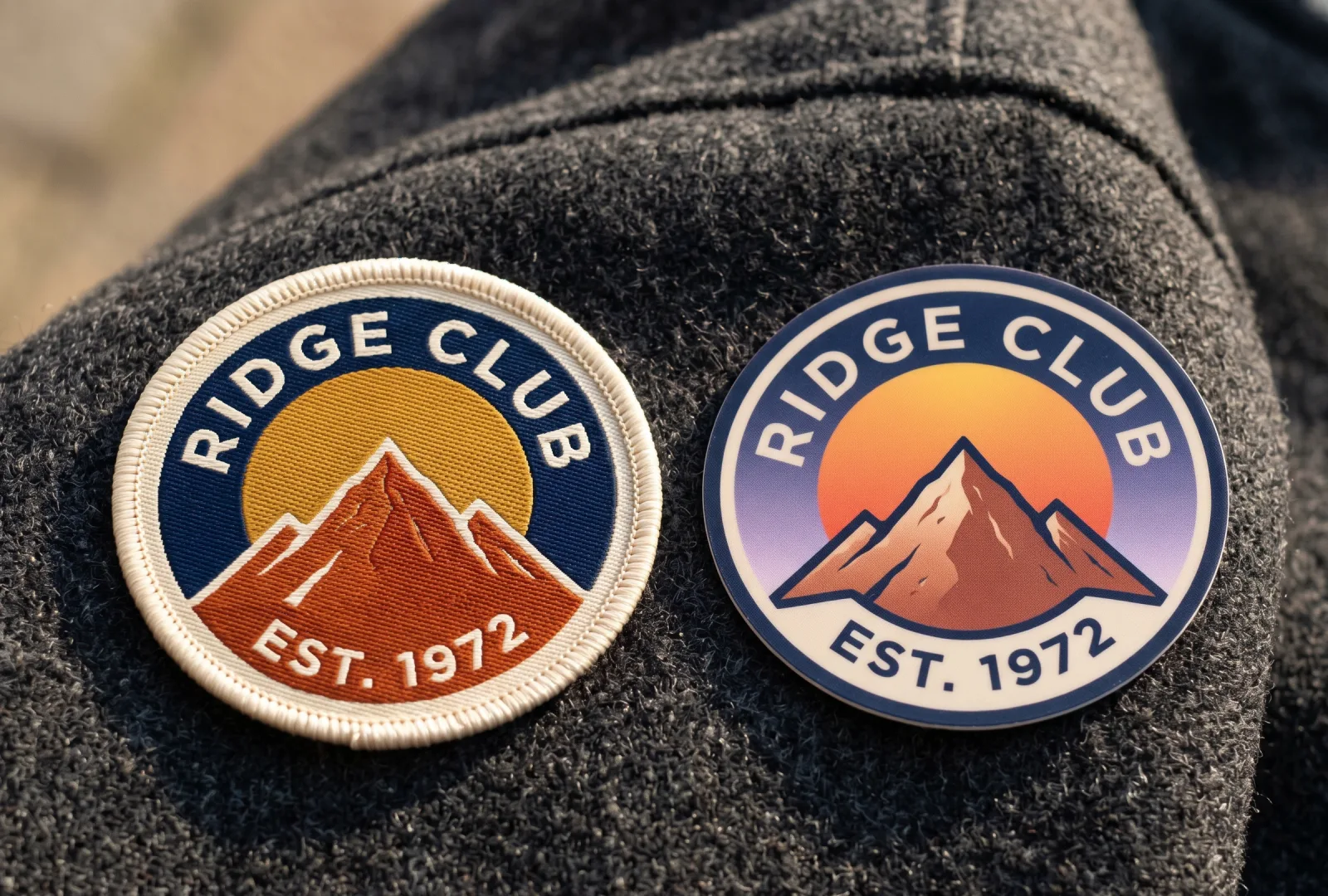
Patches are the most size-sensitive label type because they sit on the outside and act as visual identifiers. There's no "single correct" patch size — the answer depends on whether it's a chest, sleeve, back or accessory placement.
- Polo / tee left chest: 60–80 mm wide
- Jersey chest sponsor: 80–100 mm wide
- Workwear chest crest: 70–90 mm wide
- Aspect: roughly square or 4:3
- Jersey upper arm: 50–70 mm wide
- Cuff patch: 40–50 mm wide
- Workwear shoulder: 80–100 mm wide
- Aspect: narrower (3:4 portrait) so it wraps cleanly
- Junior crest: 70 × 80 mm
- Senior crest: 80 × 100 mm
- Premier school: 90 × 110 mm
- Embroidered or woven; iron-on backing optional
- Cap front patch: 55 × 50 mm (constrained by cap panel)
- Beanie woven loop label: 30 × 60 mm
- Bag woven main label: 50 × 80 mm
- Backpack rear logo: 80–120 mm wide
Anything below 40 mm wide starts losing detail on woven patches (text becomes too dense). Anything above 150 mm needs a heavyweight backing layer or it sags after a few washes. For a deeper dive, see woven vs printed patches.
6. Printed ribbons
Ribbons are sold by width and ordered by length (in metres). They're used for packaging, gift wrap, garment trim, lanyards and decorative edges on hospitality linen.
Length comes in standard rolls of 50 m, 100 m or 500 m. Printed ribbons can hold continuous brand text (repeating wordmarks) or block branding at fixed intervals — useful for cutting into garment trims or lanyard segments.
7. Name & number tapes (hostels, schools, uniforms)
Name & number labels — also called name tapes — are narrow woven strips that hold a roll number, room number, or individual name. Used everywhere there's a common laundry: hostels, boarding schools, hospitals, sports clubs.
- Compact name tape: 15 × 40 mm — fits "Room 204" or a short name
- Standard name tape: 20 × 60 mm — fits full name (e.g. "Rajesh Kumar M.")
- Combined name + room: 25 × 80 mm — two-line layout ("B-204 / Rajesh M.")
- Number-only tape: 15 × 25 mm — quick laundry-sort identifier
These are produced as continuous reels and stitched into the inside collar or waistband. For the operational playbook on hostel laundry, see hostel name & number labels.
8. School logo crests & uniform patches
School crests sit on the blazer left chest, blazer pocket, or shirt sleeve. The size depends on age group and the formality of the institution.
- Shirt pocket crest: 50 × 60 mm
- Blazer pocket crest: 60 × 70 mm
- Sleeve crest: 40 × 50 mm
- Use printed satin or simple woven — kids' uniforms wash hard
- Shirt pocket: 60 × 70 mm
- Blazer crest: 80 × 100 mm
- House badge: 40 × 50 mm
- Woven crest or embroidered patch — looks more formal
For the woven vs patch vs printed decision on school logos, see how to pick the right school uniform logo label.
9. Tagless heat-press & silicone labels
Heat-press labels replace the fabric neck label entirely — the brand mark and care info are screen-printed directly onto the inside of the garment in soft ink or silicone. Used heavily in activewear, innerwear and yoga apparel where any seam touches skin.
- Brand-only heat transfer: 30 × 40 mm — wordmark + size
- Brand + care heat transfer: 40 × 80 mm — wordmark, size, wash symbols, fibre content
- Silicone 3D dome label: 25 × 50 mm — premium activewear, raised tactile feel
- Multilingual export tagless: 50 × 110 mm — care info in 4–6 languages
Heat-press cannot be folded (it's part of the fabric), so the printed dimension is the visible dimension. Read the activewear breakdown in tagless heat-press labels for activewear.
10. Fold styles change the cut size
The cut size (the flat dimension before folding) is what you actually order. The visible size is what the wearer sees. Different folds change the ratio between the two.
- Cut = visible. Simplest, cheapest.
- Used for hem tags, side-seam, sewn-on patches
- Edges are heat-sealed on satin/taffeta to prevent fraying
- Two ends folded behind; visible = full label
- Cut adds ~10 mm total (5 mm each end)
- Most common for neck labels
- Folded in half, both sides print
- Cut = 2 × visible height + 4 mm fold allowance
- Used for hem tags, double-sided neck labels
- Folded twice or three times, accordion-style
- Cut = 2× to 4× visible length
- Used for long export care labels
11. How label size drives price
Label pricing scales with area, not perimeter. Doubling a 25 × 40 mm label to 50 × 80 mm quadruples its area — and roughly quadruples the unit price. Here's a representative ladder for a woven label at 1,000 pieces, single ink mix:
Two takeaways: (1) the smallest size that holds your artwork legibly is almost always the right call, and (2) jumping a "tier" (say from 25 × 40 mm to 30 × 50 mm) adds more cost than most brands expect.
12. Pre-order size checklist
Neck, hem, side-seam, sleeve or chest. Placement determines the dimension envelope before anything else.
Straight-cut, end-fold, centre-fold or book-fold. This decides whether the cut size is 1×, 2× or 4× the visible size.
Smallest text should be ≥ 1.6 mm; smallest line stroke ≥ 0.4 mm on woven, ≥ 0.2 mm on print.
Always ask for a 1:1 size proof before tooling. Looks bigger on screen than on a tee — print it at actual size and hold against the garment.
Quick start: WhatsApp us your label type + garment + artwork (or just a sketch), and we'll send a 1:1 scale PDF mock-up plus two alternate size proposals within 4 hours. Message Labelwala or use the quote form.
The shortcut answer for most brands
If you've read this far and still aren't sure, here's the default that fits 70% of new fashion brands launching in India:
- Neck label: 25 × 40 mm woven, end-fold
- Care label: 25 × 70 mm satin printed, book-fold
- Size tab: 15 × 20 mm woven, loop-fold (or pre-made stock)
- Hem tag: 25 × 50 mm satin printed, centre-fold
From there, adjust larger for heavier garments (denim, outerwear) and smaller for delicate ones (tanks, innerwear). When in doubt, send us the artwork — we'll spec the rest.