
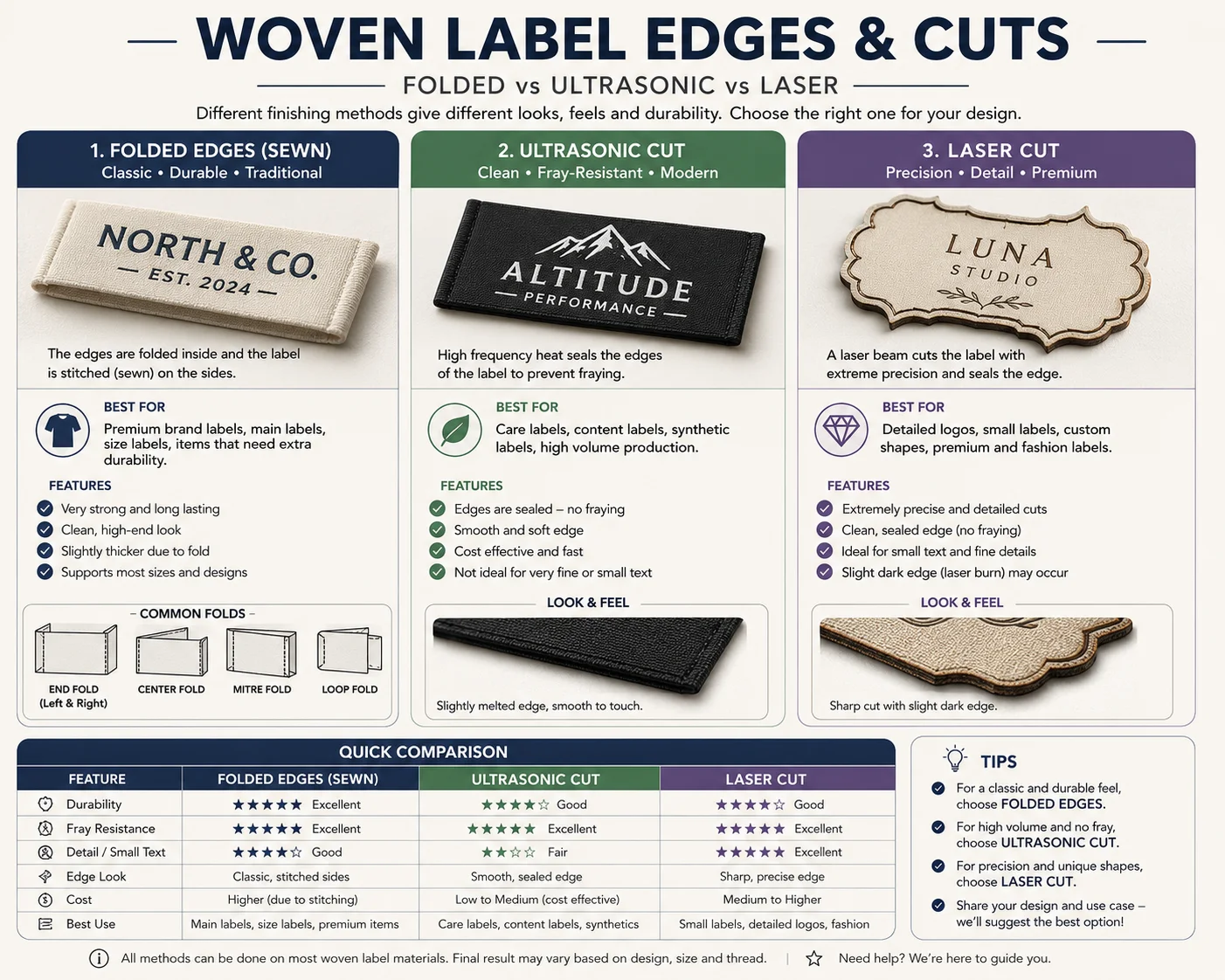
A woven label is a small rectangle cut from a long woven strip. The moment you cut fabric, you expose loose threads at the edge — and loose threads fray. Everything about "edge finish" is the answer to that one problem: how do we stop the cut edge unravelling?
There are two families of answers — seal the edge, or fold it away — and which you pick shapes how the label looks, feels and gets sewn in.
Why the edge is where cheap labels fail
A well-made woven label can carry a gorgeous logo and still be ruined by a raw, unsealed edge that frays after a few washes. The edge is one of the first things to check when you're judging label quality — a clean, secure edge signals a good label; a rough, loose one is where a cheap label starts to come apart.
A plain cold-cut edge with no sealing or fold will fray. If a quote is unusually cheap, check whether the edge is actually finished — that's often what's been skipped.
Sealing the edge: heat is the trick
Here's the lucky part: woven labels are almost always polyester, and polyester melts. That means the cut edge can be fused with heat so the threads bond and simply can't unravel. Two methods do this — and they cut and seal in a single action.
High-frequency vibration slices and fuses the edge at once. Fast and economical for straight cuts, with a clean, slightly firm sealed edge.
A focused beam follows intricate or curved outlines with precision, sealing as it goes. The choice for custom shapes and detailed patches.
Folding the edge away
The other approach doesn't seal the cut — it hides it. The raw edge is folded under and stitched through, tucking the loose threads inside the fold and the seam where they can't fray or show. This is why folded labels look so neat, and it's the traditional finish for a visible neck label. The common folds:
- End-fold (Manhattan fold) — both short ends folded under, giving a tidy flat label with hidden edges.
- Centre-fold — folded in half so the design shows on both sides, sewn into a seam at the fold.
- Loop / mitre fold — folded into a loop or angled corners for specific stitching and looks.
Folding is a topic of its own — how each fold is stitched and where it suits is covered in label fold types explained.
Edge finish vs fold type: not the same thing
These get muddled, so here's the clean distinction:
How the cut edge is sealed so it doesn't fray — heat-sealed (ultrasonic/laser) vs a plain cold cut.
How the finished label is folded before sewing — end-fold, centre-fold, mitre or loop.
A folded label hides its edges in the fold, so folding is one way of handling edges. A flat label doesn't fold, so its exposed cut edge must be heat-sealed. In practice you decide both: flat or folded, and how any exposed edge is sealed.
Which finish should you choose?
- It's a visible main or neck label
- You want the neatest, most finished look
- You need both sides to show (centre-fold)
- It's sewn into a seam or hem
- You want a modern, flat straight-cut look
- It's a custom shape or die-cut patch (laser)
- You're cost-focused on a simple rectangle (ultrasonic)
- The label is surface-applied rather than seam-sewn
Whatever you choose, feel the edge on a sample. A sealed edge should be smooth, not sharp or brittle; a folded edge should sit flat, not bulky. For a neck label, run it against your wrist — if the edge irritates there, it'll irritate at the neck.
The short answer
A woven label's edge has to be finished or it frays. Because woven labels are polyester, the cut edge can be heat-sealed — ultrasonic for fast, economical straight cuts, laser for precise shapes and patches. The alternative is to fold the raw edge away inside the fold and seam, which gives the neat look of a classic neck label. Edge finish (how the cut is sealed) and fold type (how the label is folded) are related but separate decisions — you pick both. For a visible neck label, folded usually looks best; for a flat or shaped label, make sure the edge is heat-sealed. Tell us your label and where it's sewn, and we'll recommend the finish and sample it so you can feel the edge before bulk.