
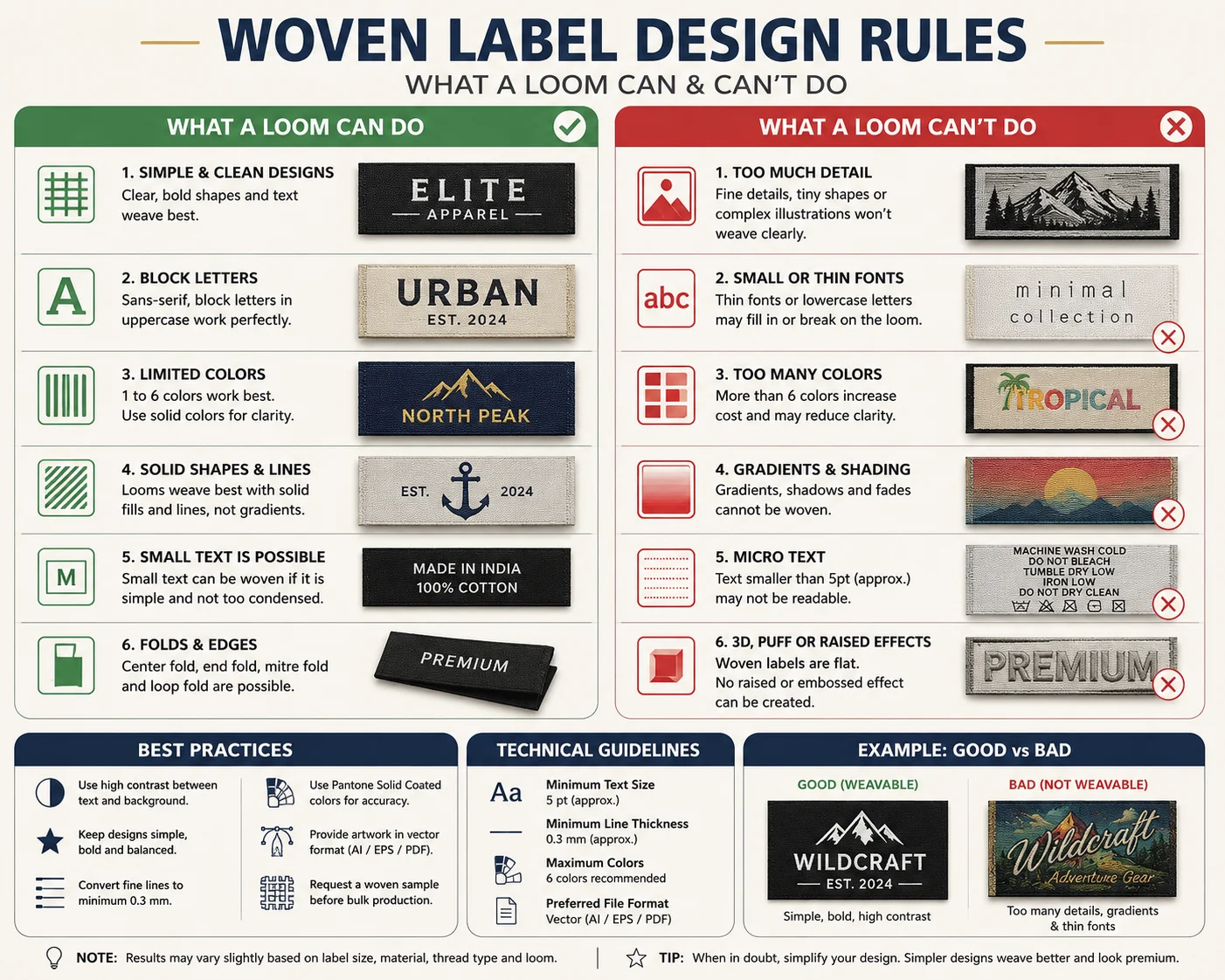
Here's the mistake almost every first-time brand makes: they send the same logo file to a woven-label supplier that they'd send to a printer, and they're surprised when the tiny tagline vanishes and the gradient turns to noise.
A loom builds your design from physical threads, so it has hard limits a printer doesn't. The good news: there are only a few rules, they're easy to design around, and once you know them your labels come out sharp every time.
Why the loom sets the rules
A printer lays continuous ink and can reproduce almost anything — photos, gradients, hairline type. A loom instead places colour one thread at a time (see how woven labels are made). That means the thread thickness is the smallest unit of detail it can produce. Anything finer than a thread simply can't exist on the label. Every rule below flows from that single fact.
Rule 1: mind your minimum sizes
Thin things are the first to disappear. Keep lines and text above the weavable minimum, or thicken them for the woven version.
If your design genuinely needs small text, don't just shrink it — move up to a higher-density or damask weave, which holds finer detail. That's the whole point of weave density.
Rule 2: gradients don't weave
This one surprises people most. A loom can't fade one colour smoothly into another the way ink does — it only has whole threads of solid colour. A gradient gets approximated by mixing two thread colours, which up close looks like a coarse dotted transition, not a smooth blend.
Got a gradient in your logo? Either simplify it to solid colours for the woven version, or use a printed label instead — print handles gradients and photographic detail far better than any weave.
Rule 3: design in solid colours, keep the palette tight
Each colour on a woven label is a separate thread the loom carries. That has two consequences: you design in flat, solid areas rather than blends, and every extra colour adds a little setup and cost. Most brands land on two to four colours; you can go higher, but a tight, deliberate palette both saves money and looks sharper.
Colours are matched from Pantone references to thread. Include your Pantone codes so the loom is set to your brand — our Pantone to thread guide explains how close the match gets. For how many colours you actually need, see the thread colours guide.
Rule 4: send the right files
Give the supplier artwork they can read exactly and scale to label size.
- Vector files — AI, EPS, PDF or SVG
- Pantone colour references for each colour
- The exact finished label size
- A note on where the label goes on the garment
- Low-resolution PNG/JPG or screenshots
- Gradients and drop shadows left in
- Hairline strokes and tiny sub-2 mm text
- No size specified, so scale is guessed
Only have a raster logo? Send the highest resolution you've got — the supplier will redraw it as vector. The full file-prep walkthrough is in our label artwork setup guide.
Adapting, not redesigning
None of this means reworking your brand. Most logos just need small, routine tweaks for weaving: thicken thin lines, enlarge or drop tiny text, flatten gradients to solids, reduce to a thread palette. Your identity stays recognisable — what changes are the technical details that would weave poorly. A good supplier does this for you and flags anything risky before weaving.
The label people see should still look unmistakably like your brand. What changes is invisible: the parts a loom couldn't have reproduced anyway.
Always approve a woven sample. The adapted artwork can look right on screen and still surprise you in thread. The sample is where you confirm the small text reads and the colours are yours — before bulk.
The short answer
A loom isn't a printer, so a woven label follows a few firm rules: keep text at roughly 2 mm or above (or go damask for finer), thicken hairlines, flatten gradients to solid colours, keep the palette tight since each colour is a thread, and send vector files with Pantone references and the exact size. Most logos need adapting, not redesigning — small tweaks that keep your brand recognisable while making it weavable. Then approve a sample. Send us your logo and we'll tell you exactly what to adjust for a clean woven result, and sample it before bulk.